
Onion Farming in Kenya: Varieties, Regions, Costs & Profitable Market Timing
Kenya imports half its red onions from Tanzania. That supply gap is your commercial opportunity. Here's everything you need to plan, plant, and profit from onion farming in Kenya.
- Kenya imports ~50% of its red onions — a major local farming opportunity
- Red Coach F1 yields up to 25 tonnes per acre under good management
- Best growing regions: Kajiado, Naivasha, Karatina, Nanyuki, Narok
- Drip irrigation is essential for consistent yields and bulb quality
- Plant August–September to harvest December at peak prices
- Farm gate prices range from KES 30 to KES 150 depending on season

onion farming kenya bulb red
Kenya has one of the most paradoxical food supply situations in East Africa. Onions are used in virtually every Kenyan household, every restaurant, every food stall. Yet the country imports approximately 50% of its red onion supply from Tanzania, according to FAO data.
That gap is not a problem. It is a commercial opportunity. And a growing number of Kenyan farmers are recognising it.
Onion farming in Kenya is gaining momentum precisely because the domestic market is so clearly under-supplied. A crop that can be grown year-round with irrigation, that stores well post-harvest, and that commands consistent demand from urban markets is a rare combination in commercial horticulture.
But success in onion farming requires more than planting and waiting. Variety selection, soil management, irrigation strategy, pest and disease control, and — critically — timing your harvest to hit the market when prices are highest all determine whether your acre returns KES 150,000 or KES 600,000.
This article covers all the variables that matter for profitable onion farming in Kenya, from the right regions and varieties to a realistic cost-and-profit breakdown and the seasonal market dynamics that separate successful farmers from struggling ones.
Best Regions for Onion Farming in Kenya

onion growing regions kenya map
Not every part of Kenya is equally suited for onion production. The crop has specific requirements — well-drained soil, appropriate temperature range, and reliable water supply — that are best met in certain counties and elevations.
Kajiado county — particularly the Isinya and Oloitoktok areas — is widely regarded as Kenya's most important commercial onion-growing zone. The combination of well-drained volcanic soils, a reliable water table, warm days, and cool nights creates near-ideal conditions for bulb development. Farmers here consistently achieve yields at the higher end of the national range.
The Naivasha and Mai Mahiu corridors in Nakuru county benefit from proximity to major road transport infrastructure, making market access straightforward. Nyeri's Karatina area has a strong tradition of onion production, and the cooler high-altitude climate produces onions with excellent firmness and long shelf life — qualities that command premium prices from Nairobi buyers.
Altitude range for onion farming: Onions can be grown at altitudes from sea level to approximately 1,900m above sea level in Kenya. The sweet spot for commercial bulb quality is 500–1,500m — high enough to provide cool nights that promote bulb formation, but not so high that temperatures suppress growth. Irrigated farming in lower-altitude warm zones like Kitui is viable but requires careful temperature management.
Best Onion Varieties for Kenya: Performance and Market Fit
Variety selection is one of the most consequential decisions in onion farming. The wrong variety in a given region — or a variety with poor market acceptance regardless of yield — can undermine an otherwise well-managed operation.
| Variety | Type | Days to Maturity | Yield (tonnes/acre) | Disease Resistance | Market Fit |
|---|---|---|---|---|---|
| Red Coach F1 | Hybrid | 90–100 | 20–25 | High | ★ Best seller |
| Jambar F1 | Hybrid | 90–110 | 18–22 | High | Excellent |
| Red Creole | Open-pollinated | 100–120 | 10–15 | Moderate | Good — long shelf life |
| Red Passion | Hybrid | 85–95 | 15–20 | High | Strong local demand |
| Islero F1 | Hybrid | 90–100 | 18–23 | High | Premium export quality |
| Red Pinnoy | Hybrid | 90–100 | 16–20 | Good | Uniform bulbs, market ready |
Red Coach F1 consistently ranks as the most commercially successful variety in Kenya. Its deep red colour, large uniform bulbs, and exceptional yield potential (up to 25 tonnes per acre under optimal management) align perfectly with what Nairobi wholesale markets and export buyers want. It matures in 90–100 days and has strong disease resistance.
For farmers prioritising seed cost over hybrid performance, Red Creole remains a viable open-pollinated option. It offers excellent shelf life and strong pungency preferred by some regional markets, though yields are considerably lower than hybrids. It is also significantly cheaper per kilogram of seed.
Seed sourcing matters: Purchase certified seeds from KEPHIS-accredited dealers only — Kenya Seed Company, Simlaw Seeds, East African Seed Company, and established agrovets. Counterfeit and uncertified seeds are a significant problem in some Kenyan markets and can result in poor germination, disease susceptibility, and non-uniform bulb development that fails at the grading stage.
From Nursery to Harvest: The Full Production Timeline
🧅 Onion Production Timeline in Kenya
Seedlings are ready for transplanting when they reach pencil-thickness and approximately 15cm in height, with 3–5 well-formed leaves. This typically takes 6–8 weeks in the nursery. Transplanting should be done in the early morning or late afternoon to minimise transplanting shock.
The standard transplanting spacing for commercial production is 8–10cm between plants and 30cm between rows. Tighter spacing produces smaller bulbs; wider spacing increases bulb size but reduces total yield per acre. Most commercial farmers target the 8–10cm spacing for an optimal balance of bulb size and total production volume.
Harvest timing is indicated by yellowing and falling over of the top leaves. This typically coincides with dry, hot weather. Harvest should always be done on dry days — moisture at harvest significantly increases the risk of fungal rots during curing and storage. After uprooting, onions are left in the field for 1–2 weeks to cure before leaves and roots are trimmed.
Cost and Profit Per Acre: A Realistic Breakdown
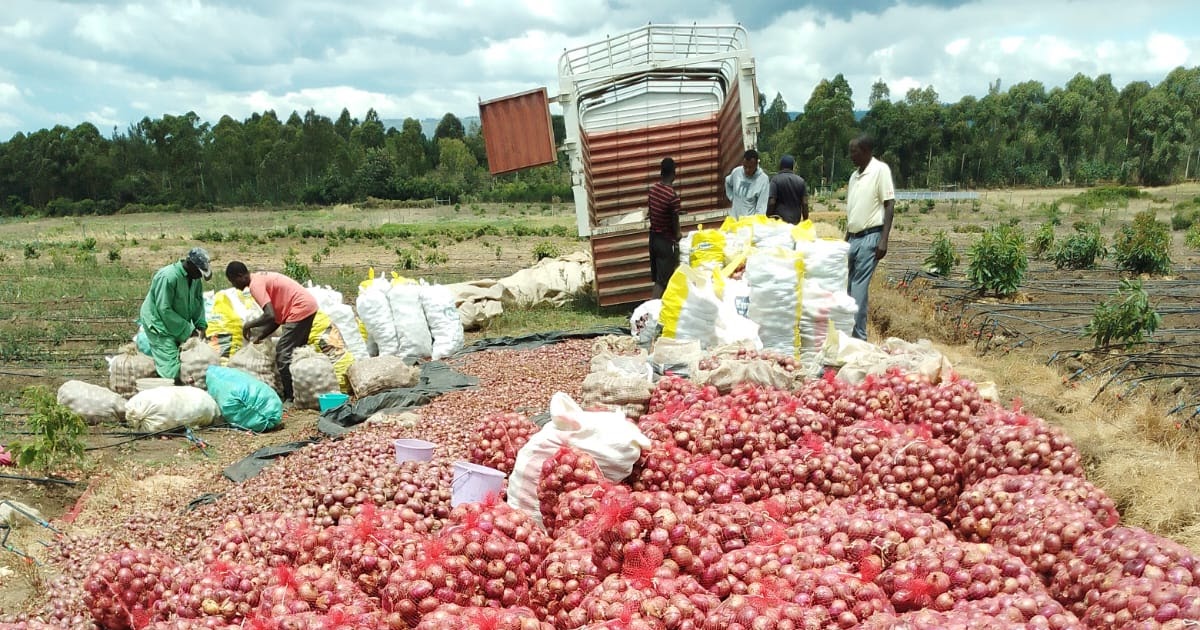
onion farming profit per acre kenya harvest
The financial case for onion farming in Kenya is compelling — but only when based on realistic inputs and market price assumptions. Here is a structured cost and revenue analysis for one acre of irrigated bulb onion production.
The drip irrigation setup cost (approximately KES 165,000 per acre) is a significant one-off capital investment that is amortised across multiple seasons. Farmers who already have irrigation infrastructure in place have a substantially lower cost base. For new entrants, this represents the most significant barrier to entry — and also the most significant quality differentiator, since irrigated onions consistently outperform rainfed production.
Profit multiplication strategy: The difference between KES 350,000 and KES 800,000 net profit from the same acre is almost entirely a function of harvest timing. Farmers who target December harvest — when Tanzanian import volumes drop and domestic demand peaks — consistently achieve farm gate prices in the KES 70–150/kg range. Those who harvest in March–April into peak Tanzania import season face prices as low as KES 15–30/kg. Timing is the single most high-leverage decision in Kenyan onion farming.
Seasonal Market Timing: When to Plant for Maximum Profit
📅 Onion Price Seasonality in Kenya — Monthly Overview
The March–May period consistently produces the lowest farm gate prices for Kenyan onion farmers. This coincides with Tanzania's peak export season into Kenya. Tanzanian onions — smaller, more pungent, and extremely competitively priced — flood Kenyan wholesale markets during this period, depressing prices to as low as KES 15–20 per kg in some years.
December is the most commercially valuable harvest month. It represents the convergence of two factors: high domestic demand driven by the festive season and reduced Tanzania import volumes. Farmers who harvest in December regularly achieve farm gate prices of KES 70–100+ per kg. In years with poor Tanzania harvests, prices can spike to KES 130–150 per kg.
The February peak is a secondary opportunity. Post-January supply tightening — after Christmas-season stocks are depleted but before Tanzania's new season volume reaches Kenyan markets — creates a brief but high-value selling window.
Pest and Disease Management: Protecting Your Yield
onion pests diseases kenya thrips mildew
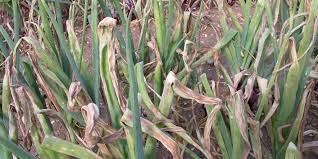
Disease and pest pressure is one of the most significant yield loss factors in Kenyan onion farming. The warm, humid conditions during the growing season create an environment where fungal diseases and insect pests can devastate an unprotected crop rapidly.
Key Diseases
Downy mildew is the most widespread and damaging fungal disease in Kenyan onion farms. It presents as pale grey spots on leaves that cause collapse of the foliage. Control requires maintaining field hygiene, avoiding overhead irrigation that splashes spores, and applying systemic fungicides like Ortiva or Ridomil Gold at the first sign of infection.
Purple blotch produces water-soaked lesions on leaves that develop into brown-purple spots. It is most severe in high-humidity conditions. Fungicides containing iprodione or mancozeb are effective; spacing plants appropriately to allow airflow also reduces incidence significantly.
Fusarium rot causes yellowing of roots and bulb rot. It is seed-borne and soil-borne. Using certified disease-free seed and practising crop rotation — avoiding replanting onions on the same ground in successive seasons — is the primary prevention strategy.
Key Pests
Thrips are the most economically damaging insect pest on Kenyan onion farms. They feed on leaves and can transmit viral diseases while causing direct physical damage. Monitor fields weekly and apply insecticides like Alonze 50EC or Escort 19EC when populations exceed threshold levels. Avoid repeated use of the same active ingredient to prevent resistance development.
Onion maggots and leaf miners are secondary but significant pests. Integrated pest management (IPM) — combining cultural practices, crop rotation, and targeted chemical intervention — produces better long-term results and lower input costs than calendar-based spraying.
Weed management is critical: Weeds compete directly with onions for water and nutrients, can harbour pests and diseases, and significantly reduce harvest efficiency. Chemical weed control using a selective herbicide (such as Commander) applied two weeks after transplanting is the most practical approach for commercial-scale farms. Manual weeding is an alternative but dramatically increases labour cost per acre.
Post-Harvest, Storage, and Market Access
Post-harvest management is where many Kenyan onion farmers lose value they have worked four months to create. Improper curing, inadequate storage, and poor market timing can convert a high-yield crop into disappointing financial returns.
Curing is essential. Freshly harvested onions contain too much moisture for extended storage. After uprooting, leave the bulbs in the field in dry weather for 7–14 days to allow the outer skins to harden and dry. This process — called curing — significantly extends shelf life and reduces post-harvest rot. Onions that have been properly cured can remain in good condition for 2–6 months under appropriate storage conditions.
Storage should be in a cool, dry, well-ventilated space. Traditional net or mesh bags hung or stacked with airflow are the most practical solution for small and medium-scale farmers. Cold storage extends shelf life further, but the capital cost makes it viable only at larger scale or through cooperative facilities.
For market access, Nairobi's Wakulima Market (Marikiti) is the central wholesale hub for Kenyan onions. Mombasa Road wholesale markets in Mlolongo and surrounding areas also handle significant volumes. Farmers with sufficient volume should establish direct buyer relationships with Nairobi wholesalers rather than selling through local brokers — cutting out one intermediary level can improve farm gate prices by 20–35%.