Pola / Wet Market
LKR 150–250/kg
good supply periods
Colombo Supermarket
LKR 250–400/kg
organised retail
Online Delivery
LKR 750–800/kg
Kapruka / premium apps
Export (gherkin)
$0.97–$1.36/kg
FOB processed
Key Takeaways
- Pola (weekly market) is cheapest: LKR 150–250/kg in season
- Colombo supermarket retail: LKR 250–400/kg
- Online grocery delivery commands LKR 750–800/kg
- Kalpitiya (Puttalam) is Sri Lanka's key cucumber-growing region
- HORDI released 6 recommended varieties including HORDI Green and Kalpitiya White
- Sri Lanka exports ~US$9m/year in cucumbers and gherkins
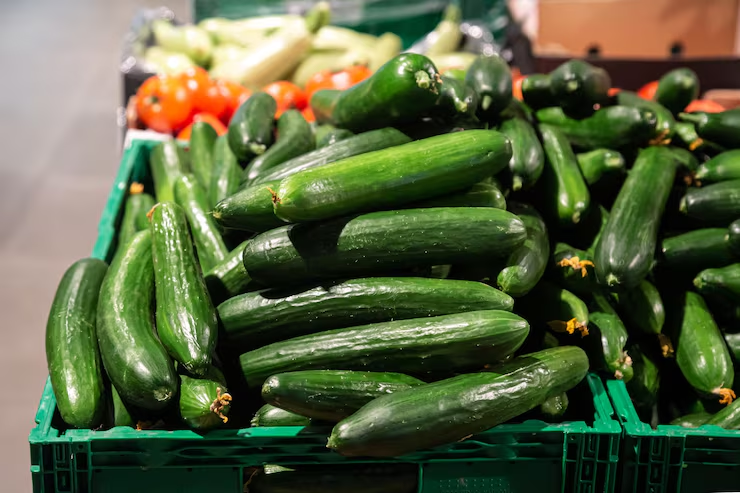
Sri Lanka's cucumber market is one of the most quietly interesting fresh produce stories in South Asia. The island grows the vegetable across most provinces, year-round in the wet zone and seasonally in the dry zone. Yet prices vary enormously — from LKR 150 per kg at a rural weekly market in good season to LKR 800 per kg on an online delivery app in Colombo.
That price gap is not arbitrary. It is the product of geography, channel markups, post-harvest losses, economic pressures following the 2022 economic crisis, and the structural differences between how urban and rural Sri Lankans access fresh produce.
Green cucumber (Cucumis sativus) is consumed across Sri Lanka in two primary ways: as a cooking vegetable sliced into curries and stir-fries, and as a raw salad vegetable eaten at meals. Both uses rely on the same domestically grown green-skinned varieties — primarily HORDI Green and regional selections — that are sold through the country's traditional pola markets, wholesale hubs, supermarkets, and a growing online delivery channel.
Understanding where green cucumber prices sit — and why they sit there — matters for everyone from home buyers budgeting for the weekly shop to food service operators managing ingredient costs to agricultural researchers tracking the country's vegetable supply chain performance.
US$9.14mAnnual cucumber/gherkin export value (2019)
30°COptimal growing temperature for Sri Lanka cucumber
6HORDI-recommended cucumber varieties for local farming
pH 5.5–7.5Soil pH range suitable for cucumber in Sri Lanka
Sri Lanka's cucumber market also has a significant export dimension that most consumers are unaware of. The country exports cucumbers — primarily as processed gherkins in brine — to Japan and European markets, generating export revenues that make cucumber one of Sri Lanka's more commercially active vegetable exports.
Green Cucumber Price by City in Sri Lanka

Sri Lanka's produce prices show clear geographic patterns. Cities closest to major growing zones — or well connected to them — tend to have lower prices. Colombo, despite being the economic hub, does not necessarily have the lowest prices because produce must travel to reach it from growing zones in the North Central, North Western, and Uva provinces.
🏙️
Colombo
Manning Market wholesale
LKR 250–400/kg retail
🏔️
Kandy
Central Province hub
LKR 200–320/kg retail
☀️
Jaffna
Northern dry zone
LKR 180–350/kg retail
🌊
Galle
Southern Province
LKR 200–350/kg retail
🌿
Anuradhapura
Near growing zone
LKR 150–250/kg retail
🏝️
Kalpitiya area
Primary production zone
LKR 80–160/kg farm area
The Kalpitiya area in Puttalam district stands out on this comparison because it is one of Sri Lanka's most productive cucumber-growing zones. Prices near production areas can be substantially lower than urban retail rates — sometimes less than half — because the supply chain is much shorter, without the intermediaries, transport costs, and urban markups that accumulate by the time cucumber reaches a Colombo supermarket shelf.
Colombo's Manning Market is the country's primary wholesale vegetable hub. Cucumber arrives here from all major producing regions, is redistributed to Colombo retail vendors and supermarkets, and prices at the Manning Market wholesale level typically run 40–60% below consumer retail pricing. Restaurant buyers and institutional purchasers who access Manning Market pricing capture a meaningful cost advantage versus buying at retail.
Jaffna's prices reflect its dry zone production context. The Northern Province produces cucumbers during the Maha season (October–February), when northeast monsoon rains support irrigation. During the off-season, Jaffna depends on produce transported from the North Central or North Western provinces, which adds logistics cost and typically pushes prices higher.
Pola vs supermarket price gap: Sri Lanka's traditional pola (weekly open-air markets, held on rotating weekly schedules in each town) consistently offer lower cucumber prices than supermarkets. The pola system connects farmers and small traders directly with consumers, cutting out the supermarket's infrastructure cost markup. For price-conscious buyers in any Sri Lankan city, identifying the local pola schedule is consistently the most effective way to access the lowest fresh vegetable prices.
Sri Lanka Green Cucumber Varieties and Their Price Differences
Sri Lanka's Department of Agriculture, through its Horticultural Research and Development Institute (HORDI), has developed and released several cucumber varieties specifically suited to Sri Lankan growing conditions. Each has distinct characteristics that affect both cultivation suitability and market pricing.
🟢
HORDI Green
DOA recommended cooking type
LKR 150–280/kg
Standard cooking cucumber. Green-skinned, widely grown. Most common variety in wet markets and pola nationwide.
⬜
HORDI White / Kalpitiya White
Salad type, light skin
LKR 200–350/kg
White-skinned salad cucumber. Popular in urban supermarkets and hotels. Mild flavour, preferred for raw eating.
🏅
Champion
High-yield commercial variety
LKR 160–280/kg
Commercially productive variety favoured by larger farms. Strong growth, good yield per vine. Standard market grade.
🫙
Gherkin Type (LY 58 / small)
Export processing variety
Contract rate (export)
Small, bumpy-skinned cucumbers grown under contract for gherkin processing. Priced at processor-set contract rates — not retail.
The distinction between cooking-type green cucumbers (HORDI Green, Champion) and salad-type white cucumbers (HORDI White, Kalpitiya White) is commercially significant in Sri Lanka. Cooking cucumbers dominate the volume market — they are the default "cucumber" at most pola vendors and wet markets. Salad cucumbers, with their lighter skin and milder flavour, occupy a premium niche in urban supermarkets, hotels, and the food service sector.
Gannoruwa White, developed at the Gannoruwa research station in Kandy district, is another salad-type variety available through the Central Province. Its proximity to Kandy means it is particularly common in Central Province markets.
Cucumber Price by Channel: From Farm Gate to Doorstep
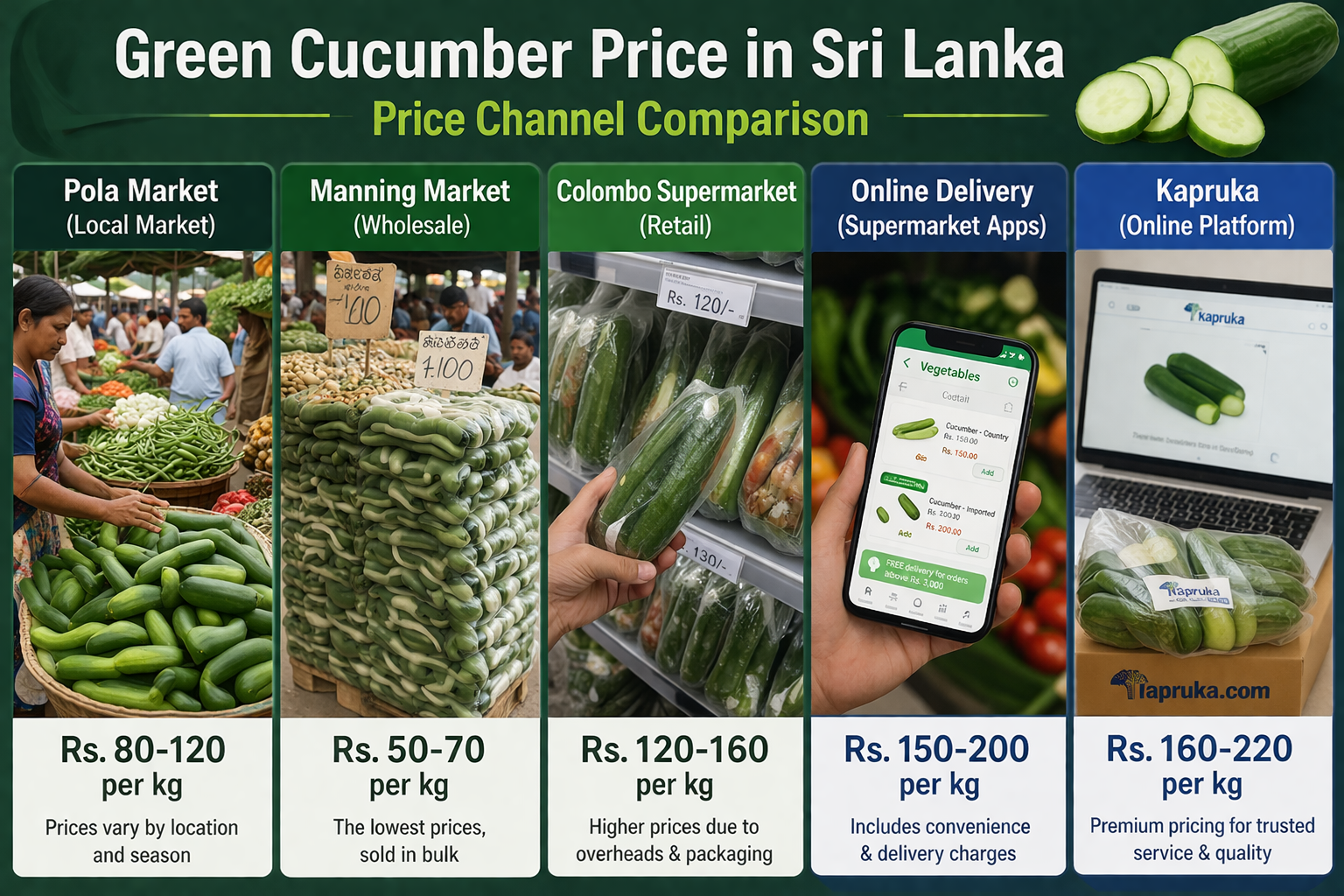
How you buy cucumber in Sri Lanka determines your price almost as much as where you buy it. The spread between the cheapest and most expensive channels is extreme — more so than in most produce categories.
🥒 Green Cucumber Price by Channel — Sri Lanka (LKR per kg)
Farm gate (Kalpitiya)
LKR 90 avg
Manning Mkt wholesale
LKR 150 avg
Pola / wet market
LKR 200 avg
Supermarket (Colombo)
LKR 320 avg
Online delivery (app)
LKR 700 avg
Premium international
LKR 900+ avg
| Channel | Price (LKR/kg) | Approx USD/kg | Min Purchase | Best For |
|---|
| Farm gate (Kalpitiya) | 60–120 | $0.17–$0.33 | 50kg+ | Processors, large buyers |
| Manning Market wholesale | 100–200 | $0.28–$0.56 | 10–25kg | Retailers, restaurants |
| Pola / weekly market | 150–250 | $0.42–$0.69 | 500g–2kg | Households |
| Supermarket (Colombo) | 250–400 | $0.69–$1.11 | 250g–1kg | Urban consumers |
| Online delivery | 600–800 | $1.67–$2.22 | 250g pack | Convenience buyers |
| Premium hotel/export | 800–1,000+ | $2.22–$2.78 | Varies | Hotels, special grade |
The online delivery premium in Sri Lanka is particularly notable. Kapruka's pricing of approximately US$2.50/kg (LKR 750–800/kg at current exchange rates) for 500g of cucumber represents a price 5–8× higher than farm-gate rates in the Kalpitiya growing area. Even against pola prices, the online premium is 3–4×. This extreme markup reflects the cost of last-mile cold chain delivery, platform fees, and imported packaging — but it also reflects the limited scale of Sri Lanka's online grocery market, which has not yet achieved the volume needed to bring per-unit costs down.
Where Sri Lanka Grows Its Cucumbers
Sri Lanka's cucumber production is spread across most provinces, but certain regions have developed particular commercial significance.
🌊
Kalpitiya, Puttalam
North Western Province
Primary commercial zone
🌾
Anuradhapura, Polonnaruwa
North Central Province
Large-scale Maha season
🏔️
Kandy, Nuwara Eliya
Central Province
Year-round cool zone
☀️
Jaffna, Kilinochchi
Northern Province
Maha season primary
🌿
Badulla, Monaragala
Uva Province
Year-round wet zone
🏖️
Hambantota, Matara
Southern Province
Seasonal coastal supply
Kalpitiya's prominence in Sri Lanka's cucumber market is well-established. The peninsula's sandy soils, warm climate, and proximity to underground water sources create excellent conditions for cucumber cultivation. The Kalpitiya White variety — recognised officially by the Department of Agriculture — takes its name from this region, testament to how closely associated Kalpitiya is with cucumber production in the national agricultural identity.
The Department of Agriculture specifies that cucumber is suitable for cultivation up to 1,000 metres above sea level, which opens up much of Sri Lanka's Central Province to production. Gannoruwa in Kandy district hosts one of HORDI's key research stations, which is why the Gannoruwa White variety was developed and is particularly available through Central Province markets.
Growing season structure: Sri Lanka's agricultural calendar divides into two main seasons — Maha (October–March, northeast monsoon) and Yala (April–September, southwest monsoon). In the dry zone (North, North Central, North Western), cucumber is primarily a Maha crop, relying on monsoon rainfall and irrigation from tanks and wells. In the wet zone (Central, Uva, Sabaragamuwa, Western), cucumber can be grown year-round with appropriate drainage management. This complementary seasonality means Sri Lanka has potential for consistent year-round supply — though post-harvest infrastructure gaps mean supply gaps still occur.
Seasonal Price Patterns for Cucumber in Sri Lanka
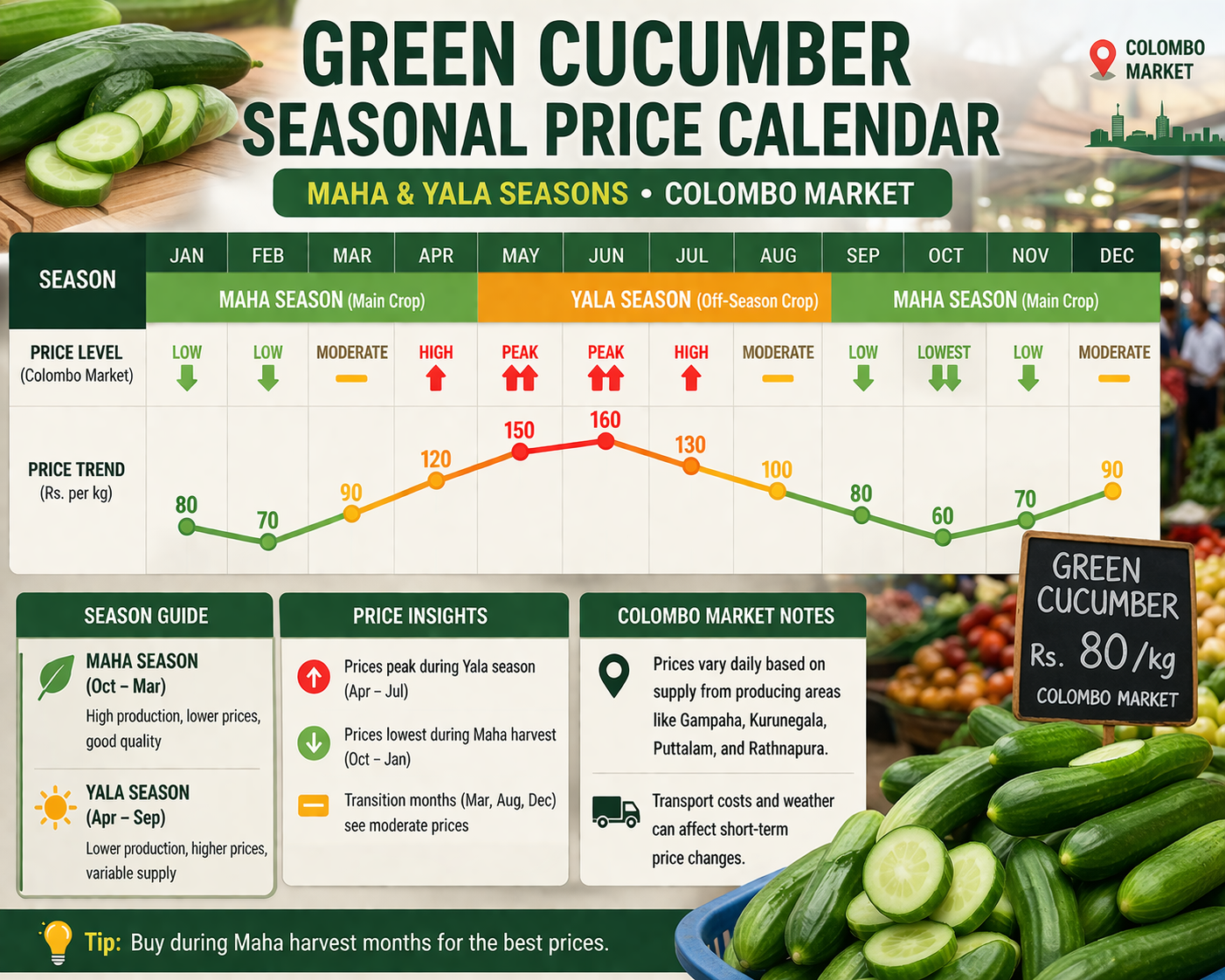
📅 Sri Lanka Cucumber Price Seasonality — Monthly Overview
Jan
Feb
Mar
Apr
May
Jun
Jul
Aug
Sep
Oct
Nov
Dec
Peak supply — lowest prices
Good supply — moderate prices
Low supply — highest prices
Sri Lanka's cucumber price seasonality is closely tied to the Maha growing season. Dry zone production in the North Central and North Western provinces peaks in January–March, when the Maha harvest coincides with good logistics conditions (dry roads, low rainfall). Prices typically fall to their annual lows during this period.
The June–August period is historically Sri Lanka's most challenging for cucumber supply. Southwest monsoon rains disrupt transport, reduce harvest access to wet zone fields, and create quality degradation from excess moisture. CEIC historical data for Colombo showed peak cucumber prices reaching LKR 152.88/kg in February 2017 (likely a supply shock rather than a seasonal pattern) and a record low of LKR 38.24/kg in April 2006.
December sees a secondary supply peak as dry zone Maha planting from October–November begins producing. This pre-Christmas supply window is commercially important for food service operators in Colombo and the Southern coast's tourist areas, where demand from hotels and restaurants accelerates in the festive and tourist season.
LKR Depreciation and Its Effect on Sri Lanka's Cucumber Market
No analysis of Sri Lanka's current food prices can ignore the context of the 2022 economic crisis. The rupee depreciated from approximately LKR 200 per USD in early 2022 to over LKR 360 per USD at the peak of the crisis, before stabilising in the LKR 310–360 range in subsequent years.
For domestically grown vegetables like cucumber, the effect is not as direct as for imported goods. Cucumber is grown in Sri Lanka using local land, local labour, and in most cases local water. In that sense, it is less import-cost-exposed than, say, imported cheese or fuel.
However, input costs for Sri Lankan cucumber farmers have a significant dollar-linked component. Fertilisers — primarily urea and compound fertilisers — are imported and priced in or linked to USD. Agrochemicals (fungicides, pesticides) are imported. Diesel fuel for irrigation pumps follows international oil prices. When the LKR weakens, these input costs rise in LKR terms even if global USD prices are stable, pushing farm-gate costs up and compressing farmer margins.
For consumers, the combined effect of LKR depreciation and input cost inflation has been that LKR-denominated prices for all vegetables including cucumber are meaningfully higher than pre-crisis historical benchmarks. CEIC data showed Colombo retail cucumber averaging LKR 71.82/kg as a long-run monthly median. Post-crisis retail prices in the LKR 250–400/kg range represent a 3–5× increase in LKR terms from that historical average.
For international buyers and exporters: Sri Lanka's LKR depreciation has had the secondary effect of making Sri Lankan exports — including gherkins and processed cucumbers — more competitive in USD terms. Sri Lanka's gherkin export industry, which ships preserved gherkins in brine primarily to Japan and European markets at $0.97–$1.36/kg, benefits from lower LKR-denominated production and processing costs translating into more competitive USD pricing for international buyers.
Sri Lanka's Cucumber Export Industry: Gherkins to Japan and Europe
Most discussions of Sri Lanka's cucumber market focus exclusively on domestic retail. But the country has a commercially significant export industry that shapes how part of the cucumber crop is priced, graded, and contracted.
Sri Lanka exported cucumber and gherkin products valued at approximately US$9.14 million in 2019, making it one of the more commercially active cucumber exporters in Asia. The primary product is gherkins preserved in brine — small cucumbers packed in salt solution, classified under HS code 071140 — sold to food processors and distributors in Japan and Europe.
This gherkin export industry operates on a contract farming model. Processors contract farmers to grow specific small cucumber varieties (including LY 58 and similar compact types) to defined size specifications. Farmers receive contract prices per kg of harvested gherkins, which are independent of and typically below what larger fresh cucumbers fetch in retail markets.
Japan is Sri Lanka's primary gherkin export destination, importing Sri Lankan gherkins for use in Japanese food manufacturing and food service. European buyers — particularly from Germany and other key gherkin-consuming markets — also source from Sri Lanka. The most recent Tridge data shows a transaction as recently as February 2025 with gherkins exported to Japan in barrels of 190kg, confirming the industry remains commercially active.
Import activity too: Sri Lanka also imports gherkins — primarily from India — for further processing and potential re-export. This processing-for-re-export model adds value through brining, quality sorting, and repackaging before the product reaches final markets. The import price of gherkins into Sri Lanka ranged from $0.44–$1.07/kg in 2024, reflecting different grades and processing states of the incoming raw material.
📊
Related Reading
Cucumber Price Index: Wholesale, Retail & Bulk Sourcing Costs Across Global Markets →
Frequently Asked Questions: Green Cucumber Price in Sri Lanka
What is the price of green cucumber per kg in Sri Lanka?
Green cucumber retail prices in Sri Lanka range from LKR 150–250/kg at pola (weekly markets) during good supply, LKR 250–400/kg at Colombo supermarkets, and LKR 600–800/kg on online delivery platforms like Kapruka. Farm-gate prices near Kalpitiya growing areas are substantially lower at LKR 60–120/kg. Post-crisis LKR depreciation has significantly increased all LKR-denominated prices compared to pre-2022 historical benchmarks.
Where is cucumber grown in Sri Lanka?
Major cucumber-producing regions include Kalpitiya in Puttalam district (North Western Province), the North Central Province (Anuradhapura and Polonnaruwa), the Uva Province, and the Central Province. Kalpitiya is the most commercially significant production zone, lending its name to the Kalpitiya White variety. The Department of Agriculture recommends cucumber cultivation up to 1,000m altitude with an optimal temperature of 30°C and pH of 5.5–7.5.
What are the main cucumber varieties grown in Sri Lanka?
HORDI (Sri Lanka's Horticultural Research and Development Institute) has released six recommended varieties: HORDI Green (cooking type), HORDI White (salad type), Kalpitiya White, Champion, Gannoruwa White, and LY 58. Green cooking varieties dominate volume sales at pola markets. White salad types command a modest premium in urban supermarkets and hotel food service.
Does Sri Lanka export cucumbers?
Yes. Sri Lanka exports cucumbers and gherkins valued at approximately US$9 million annually, primarily to Japan and European markets. The main export product is gherkins in brine (HS 071140) produced under contract farming arrangements. Sri Lanka also imports gherkins from India for further processing and re-export. Export prices for Sri Lankan gherkins range from $0.97–$1.36/kg FOB.
How has Sri Lanka's economic crisis affected cucumber prices?
Sri Lanka's 2022 economic crisis and LKR depreciation (from ~LKR 200 to LKR 360+ per USD) has significantly increased LKR-denominated food prices including cucumber. While cucumber is grown domestically, input costs (fertiliser, agrochemicals, fuel for irrigation) have dollar-linked components that rise when the rupee weakens. Current LKR retail prices of LKR 250–400/kg represent a 3–5× increase from the historical Colombo median of ~LKR 72/kg recorded pre-crisis.
What is the wholesale price of cucumber in Sri Lanka?
Colombo's Manning Market wholesale prices for cucumber typically range from LKR 100–200/kg during normal supply periods. These prices are significantly below consumer retail and represent the pricing level at which Colombo retailers, restaurants, and food businesses source their supply. Farm-gate prices in major growing areas are lower still at LKR 60–120/kg, with the difference absorbed by transport costs, handling, and wholesale trader margin.
