
Egypt Dried Basil FOB Price 2025 & 2026
Complete export pricing guide — per kg and per tonne, by grade, by port, organic vs conventional, with buyer's checklist and seasonal outlook
Egypt is the world's single largest exporter of dried basil, supplying an estimated 15,000–20,000 metric tonnes annually to food manufacturers, seasoning companies, and herb importers across Europe, the United States, and the Middle East. If you are sourcing dried basil internationally in 2025 or planning purchases for 2026, understanding Egyptian FOB (Free On Board) pricing — by grade, quality tier, and certification status — is the most critical intelligence in your procurement toolkit.
This guide provides the most complete, publicly available breakdown of Egypt dried basil FOB prices for 2024, 2025, and the 2026 outlook, including grade-by-grade pricing per kilogram and per metric tonne, port logistics, quality specifications, documentary requirements, seasonal price windows, and the factors that drive price movement in the Egyptian export market.
Table of Contents
- 1Why Egypt Dominates Dried Basil Exports
- 2FOB Price Per Kg — 2024, 2025 & 2026
- 3Grade-by-Grade Pricing Breakdown
- 4Price Per Metric Tonne (FOB)
- 5Organic vs Conventional Pricing
- 6Quality Specifications & Grades
- 7Egyptian Export Ports & Logistics
- 8Seasonal Price Trends & Best Buying Window
- 95 Factors That Move Egyptian Basil Prices
- 10Standard Documents to Request
- 11How to Source & Negotiate
- 12Frequently Asked Questions
Why Egypt Dominates Global Dried Basil Exports
Egypt's position as the world's leading dried basil exporter is not accidental — it reflects a convergence of agronomic, economic, and logistical advantages that no other single country has been able to replicate at the same scale or cost. Understanding these structural factors is essential context for interpreting why Egyptian FOB pricing is what it is, and how stable those prices are likely to remain.
Nile Delta Agronomy
The primary basil-growing regions of Egypt are concentrated in the Nile Delta governorates of Beheira, Kafr El-Sheikh, Gharbia, and Dakahlia. The rich alluvial soils deposited by the Nile over millennia produce basil with characteristically high essential oil content — typically 0.6–1.5% by weight of dried leaf — which surpasses production from many competing origins. The flat delta terrain enables mechanized cultivation at scale, reducing per-hectare harvesting costs compared to terraced Mediterranean farms.
Climate and Growing Season
Egypt's warm Mediterranean-influenced climate along the Delta coast delivers an optimal basil growing season from April through September, with the main commercial harvest concentrated in June–August. Minimal rainfall during the growing season reduces disease pressure and allows consistent sun-drying — the predominant drying method — at very low energy cost. Processing facilities then operate at peak capacity from September through February, converting the dried harvest into export-ready grades.
Processing Infrastructure
Over decades of herb export activity, Egypt has developed a sophisticated cleaning, cutting, sieving, and packing infrastructure specifically designed for export-grade dried herbs. Facilities in the Delta processing zones routinely handle volumes of 50–500 tonnes per season and hold certifications including HACCP, ISO 22000, and — for a growing subset of exporters — EU Organic and USDA NOP. This infrastructure density gives Egyptian exporters competitive advantages in turnaround time and minimum order flexibility that emerging origins like Morocco or Ethiopia cannot yet match.
📊 Egypt in Global Dried Basil Trade — Key Facts
Egypt accounts for approximately 35–45% of total global dried basil export value based on UN Comtrade HS code 121190 data. Egypt's export value of dried basil increased by over 50% in the five-year period through 2022. The top destinations for Egyptian dried basil by value are the United States, Germany, Russia, Poland, and France, with EU-27 collectively representing the largest single market. Egyptian basil is classified under HS code 121190 — Plants and parts used in perfumery, pharmacy or for insecticidal, fungicidal purposes, fresh or dried.
Egypt Dried Basil FOB Price Per Kg — 2024, 2025 & 2026
The following FOB price ranges are compiled from trade intelligence, Egyptian exporter quotations, and cross-referenced UN Comtrade export unit value data. FOB (Free On Board) pricing means the cost of goods loaded onto the vessel at the named Egyptian port — buyers are responsible for ocean freight, insurance, import duties, and inland delivery from destination port. All prices are quoted in USD.
How to use these prices: The ranges reflect market reality — grade, essential oil content, moisture level, certifications, packaging format, and order volume all determine where within the range a given shipment is priced. Treat the lower end as achievable for contract volumes (5 MT+) with established exporters, and the upper end as applicable to small spot orders or premium organic grades.
| Grade / Form | FOB 2024 (USD/kg) | FOB 2025 (USD/kg) | 2026 Forecast (USD/kg) | Price Per MT (2025) |
|---|---|---|---|---|
| Conventional Whole Leaf (Standard) | $5.50 – $9.00 | $6.00 – $10.00 | $6.50 – $11.00 | $6,000 – $10,000 /MT |
| Conventional Whole Leaf (Premium) | $8.00 – $11.00 | $8.50 – $12.00 | $9.00 – $13.00 | $8,500 – $12,000 /MT |
| Conventional Rubbed / Cut (5–8mm) | $6.50 – $10.50 | $7.00 – $11.50 | $7.50 – $12.50 | $7,000 – $11,500 /MT |
| Conventional Powder (80–100 mesh) | $7.00 – $11.00 | $7.50 – $12.00 | $8.00 – $13.00 | $7,500 – $12,000 /MT |
| Organic Whole Leaf (EU/NOP Cert.) | $10.00 – $16.00 | $11.00 – $18.00 | $12.00 – $19.50 | $11,000 – $18,000 /MT |
| Organic Rubbed (Retail Grade) | $12.00 – $18.00 | $13.00 – $19.50 | $14.00 – $21.00 | $13,000 – $19,500 /MT |
| Spray-Dried Basil Extract | $18.00 – $30.00 | $19.00 – $32.00 | $20.00 – $34.00 | $19,000 – $32,000 /MT |
| Steam-Distilled Basil Essential Oil | $120 – $280 | $130 – $300 | $140 – $320 | $130,000+ /MT |
The year-on-year upward trend in Egyptian FOB prices from 2024 to 2025 — averaging an 8–12% increase across conventional grades — reflects a combination of Egyptian pound devaluation (which initially appears to lower USD costs but is offset by input price inflation), rising global demand from European food manufacturers expanding herb seasoning lines, and tightening EU pesticide residue maximum residue level (MRL) compliance requirements that push exporters toward more expensive but compliant production practices.
Grade-by-Grade Pricing Breakdown
Egyptian dried basil is commercially graded based on processing method, physical specification, and intended end-use. Understanding what each grade entails allows buyers to specify correctly and avoid overpaying for unnecessary processing or underpaying for inadequate quality.
Whole Leaf — Standard Grade
$6.00–$10.00
per kg FOB, 2025
Moisture ≤12%, volatile oil ≥0.3%, purity ≥97%. Sun-dried. Suitable for food manufacturing and reprocessing by importers.
Whole Leaf — Premium Grade
$8.50–$12.00
per kg FOB, 2025
Moisture ≤10%, volatile oil ≥0.5–0.8%, purity ≥99%. Better color retention, EU MRL compliant, lower stem/seed content.
Rubbed / Cut (5–8mm)
$7.00–$11.50
per kg FOB, 2025
Mechanically rubbed or cut to specification. Standard cut for retail seasoning blends and industrial spice manufacturers.
Powder (80–100 mesh)
$7.50–$12.00
per kg FOB, 2025
Finely milled. Used in capsules, seasoning powders, and food-tech ingredient applications. Higher processing cost vs whole leaf.
Organic Whole Leaf
$11.00–$18.00
per kg FOB, 2025
EU Organic or USDA NOP certified. Issued by IMO, ECOCERT, Control Union, or OCIA. Trace document chain required.
Organic Rubbed (Retail Grade)
$13.00–$19.50
per kg FOB, 2025
Premium organic, retail-ready specification. Private label packaging available from select Egyptian exporters at this tier.
Processing Method and Its Effect on Price
The predominant drying method in Egypt is sun drying, which produces the lowest-cost dried basil but with some variability in color (tending toward olive-green rather than bright green) and slightly higher microbial counts than tunnel-dried product. Exporters offering mechanical tunnel drying or forced hot-air drying produce a more consistent, brighter-colored product with better microbial control — this commands a $0.50–1.50/kg premium over sun-dried equivalents. Buyers specifying EU retail-facing product should request tunnel-dried basil; food manufacturing applications can typically accept sun-dried grades at the lower price point.
Egypt Dried Basil Price Per Metric Tonne (FOB) 2025
Buyers typically negotiate dried basil contracts in metric tonnes (MT) rather than per-kilogram terms, particularly for container-load quantities (one 20-foot FCL typically loads 5–7 MT of dried basil in cartons; a 40-foot FCL carries 10–14 MT). The following per-tonne rates are derived from the per-kg pricing above and represent realistic FOB contract prices for 2025.
| Grade | FOB Price Per Metric Tonne (2025) | FOB Price Per Metric Tonne (2026 Est.) | Typical MOQ |
|---|---|---|---|
| Conventional Standard Whole Leaf | $6,000 – $10,000 / MT | $6,500 – $11,000 / MT | 1 MT |
| Conventional Premium Whole Leaf | $8,500 – $12,000 / MT | $9,000 – $13,000 / MT | 1 MT |
| Conventional Rubbed (5–8mm cut) | $7,000 – $11,500 / MT | $7,500 – $12,500 / MT | 1 MT |
| Conventional Powder (80–100 mesh) | $7,500 – $12,000 / MT | $8,000 – $13,000 / MT | 1 MT |
| Organic Whole Leaf (EU/NOP) | $11,000 – $18,000 / MT | $12,000 – $19,500 / MT | 500 kg |
| Organic Rubbed (Premium retail) | $13,000 – $19,500 / MT | $14,000 – $21,000 / MT | 500 kg |
🚢 FCL Cost Estimate — Reference Only
A 20-foot container of conventional whole leaf Egyptian dried basil (6 MT at $8,000/MT average) has an FOB value of approximately $48,000 USD. Adding ocean freight to Hamburg (approx. $2,500/FCL), insurance (0.5%, ~$240), and import VAT (where applicable) brings total landed cost to approximately $50,750 before warehousing and inland delivery. Buyers should request DDP (Delivered Duty Paid) quotes from freight forwarders to build complete cost models before comparing supplier FOB offers.
Organic vs Conventional Egyptian Dried Basil — Price Comparison
The organic price premium for Egyptian dried basil has remained structurally stable at 65–100% above conventional equivalents for whole leaf grades, and 60–70% for rubbed grades. This premium reflects genuine production and certification cost differences rather than speculative markup.
| Factor | Conventional | Organic Certified | Price Difference |
|---|---|---|---|
| FOB Price Whole Leaf (2025) | $6.00 – $10.00/kg | $11.00 – $18.00/kg | +65–100% |
| Annual certification cost | — | $3,000 – $8,000/year | Recovered in price |
| Yield reduction (organic vs conv.) | Base yield | 15–30% lower yield/hectare | Recovered in price |
| Input cost differential | Synthetic inputs permitted | Natural inputs only (+20–40% input cost) | Recovered in price |
| Certifying bodies (Egypt) | N/A | IMO, ECOCERT, Control Union, OCIA | Certificate required for EU/US market |
| Pesticide residue testing | Standard EU MRL testing | Zero synthetic pesticide residue expected | Organic adds value in EU retail |
| Market access | Food manufacturing, foodservice | Organic retail, premium food brands | Different supply chains |
| Conversion period requirement | N/A | 36 months land conversion | Limits new organic supply |
Buyer's note on organic verification: Always verify that the organic certificate covers both the farming operation and the processing facility. Some Egyptian exporters hold farm-level organic certification but process through conventional facilities, which invalidates organic status for the finished product under EU Regulation 834/2007 and its successor 2018/848. Request full transaction certificates for each shipment.
Quality Specifications for Egyptian Dried Basil Export
Egyptian dried basil quality is assessed across five primary dimensions. Buyers who specify these parameters clearly in purchase contracts will receive more consistent product and have legal standing to reject non-conforming shipments.
| Parameter | Standard Grade | Premium Grade | Organic Grade | Test Method |
|---|---|---|---|---|
| Moisture Content | ≤12% | ≤10% | ≤10% | AOAC 925.10 |
| Volatile Oil (Essential Oil) | ≥0.25% | ≥0.5% | ≥0.5% | ISO 6571 |
| Purity (basil leaf material) | ≥97% | ≥99% | ≥99% | Visual/sieve analysis |
| Stem and seed content | ≤5% | ≤3% | ≤3% | Physical separation |
| Foreign matter | ≤1% | ≤0.5% | 0% | ISO 927 |
| Total Aerobic Count (TPC) | ≤10⁵ CFU/g | ≤10⁴ CFU/g | ≤10⁴ CFU/g | ISO 4833 |
| E. coli | Negative/10g | Negative/10g | Negative/10g | ISO 16649 |
| Salmonella | Absent/25g | Absent/25g | Absent/25g | ISO 6579 |
| Pesticide Residues | EU MRL compliant | EU MRL compliant | Zero synthetic pesticides | Multi-residue GC/LC-MS |
| Heavy metals (Pb, Cd, As) | EU limits | EU limits | EU limits | ICP-MS |
| Color (whole leaf) | Olive green to green-grey | Bright green to dark green | Bright green | Visual, Munsell scale |
Drying Method and Color Implications
Sun-dried Egyptian basil develops an olive-green to grey-green coloration — characteristic of the product and acceptable to food manufacturers. Buyers targeting retail herb jars or premium food brands should specify tunnel-dried or low-temperature forced-air dried product, which retains a brighter green color at the cost of $0.80–1.50/kg premium over sun-dried equivalents. Color specification disputes are the most common source of commercial disagreements in Egyptian basil imports — specify color expectations in writing before shipment.
Egyptian Export Ports & Logistics for Dried Basil
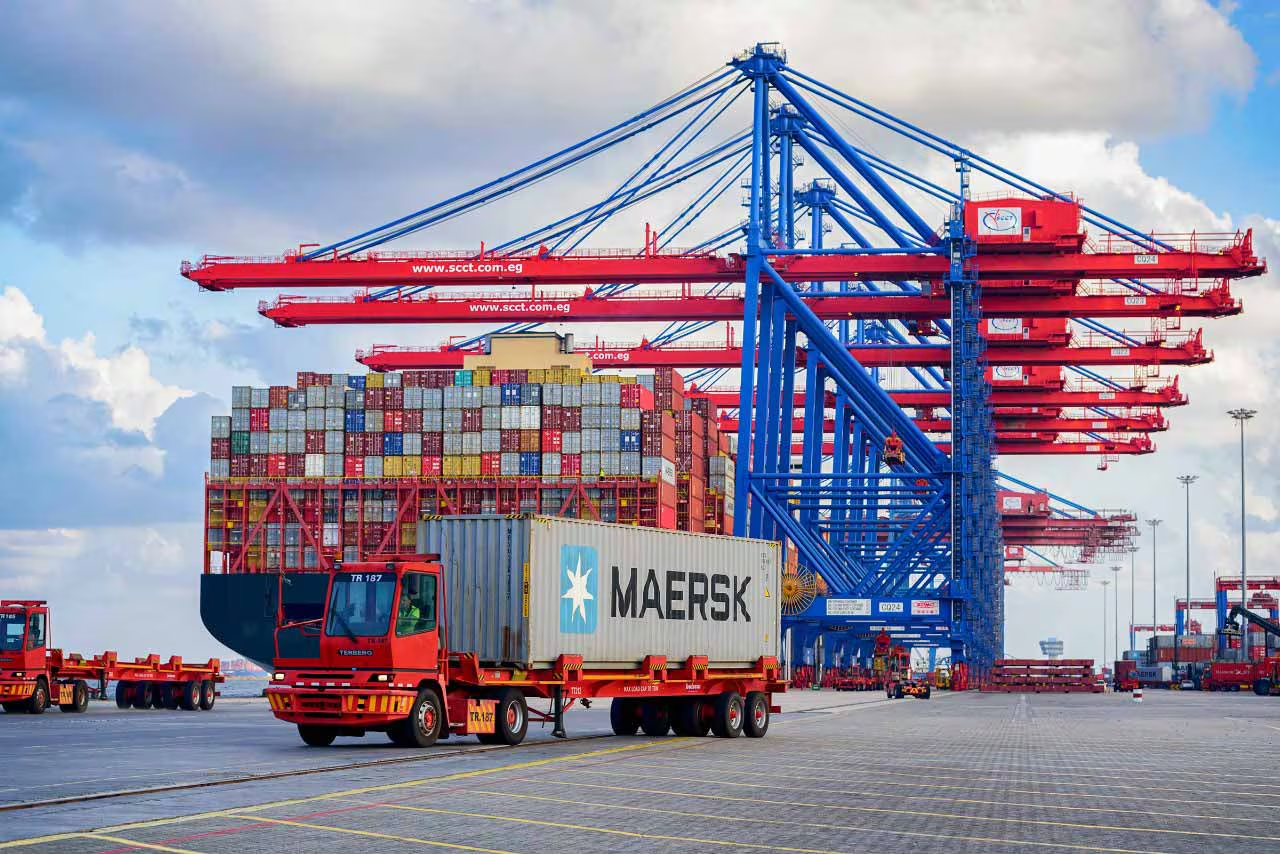
Egyptian dried basil exports move through three primary ports, each with different transit time profiles and cost implications for European, American, and Middle Eastern buyers.
| Port | Location | Primary Destination | Transit to Hamburg | Transit to New York | Shipping Lines |
|---|---|---|---|---|---|
| Port Said East | Northern Suez Canal | EU, USA, East Asia | 10–14 days | 18–22 days | MSC, Maersk, CMA CGM |
| Damietta Port | Nile Delta east | EU, Mediterranean | 9–13 days | 17–21 days | MSC, Evergreen |
| Alexandria / El-Dekhela | Mediterranean northwest | EU, North America, Middle East | 8–12 days | 16–20 days | Hapag-Lloyd, MSC, ZIM |
Packaging and Container Loading
Egyptian dried basil for export is typically packed in one of three formats: double-walled paper cartons of 10–25kg lined with food-grade polyethylene bags (most common), jute bags of 25–50kg for less moisture-sensitive product targeting industrial use, or multi-layer poly bags inside outer woven sacks for organic or premium grades. Carton packs are preferred by EU importers for their reduced moisture ingress and ease of handling at destination warehouses.
A standard 20-foot FCL loads 5.5–7 MT of dried basil in carton packaging; a 40-foot FCL carries 11–14 MT. Palletized loading (non-mandatory but increasingly requested by EU importers) reduces the load by approximately 10–15% due to pallet space. Ocean freight rates from Port Said to major European ports in 2025 range approximately $1,200–2,800 per FCL (20ft) depending on the shipping line, season, and market rate fluctuations — buyers should request freight quotes at the time of sourcing rather than relying on historical rates.
⏱ Lead Times Reference — Egypt to Destination
For existing stock orders: expect 3–5 weeks from contract to vessel departure (documentation, fumigation declaration, quality testing, customs clearance). For new crop contract orders placed pre-harvest: lead time extends to 4–6 months from contract signature to delivery, as the basil must be grown, harvested, dried, processed, and tested. Processing window (when harvest becomes export-ready) runs October–February annually.
Seasonal Price Trends & Best Buying Window
Egyptian dried basil prices follow a predictable seasonal pattern tied to the harvest and processing cycle. Understanding this cycle allows buyers to time purchases for maximum price advantage.
| Period | Market Condition | Relative Price | Buyer Action |
|---|---|---|---|
| April – June | Growing season begins; old-crop inventory depleting; pre-harvest tightness | +10–20% above average | Avoid spot buying if possible; forward contracts for new crop |
| July – August | Peak growing and early harvest; spot market thin but new crop anticipated | Stable to slightly elevated | Sign new-crop contracts; negotiate pricing ahead of processing |
| September – October | Harvest complete; processing begins; new crop enters market | Moderate — new supply available | Sample new crop lots; test quality before committing volume |
| November – January ⭐ Best Window | Peak supply; exporters competing to move inventory; maximum choice | -10–20% below annual average | Lock in annual contracts; negotiate best pricing on volume |
| February – March | Inventory still available but demand recovering; prices firming | Near average | Complete annual purchase needs; avoid leaving to spring spot market |
The November–January window represents the optimal procurement period for buyers with storage capacity. This is when Egyptian exporters have the largest inventory of the freshest crop and are most motivated to secure volume sales — making it the period when buyers have maximum negotiating leverage on price, payment terms, and contract structure. Annual contracts signed during this window typically lock in pricing that is 10–20% below what the same buyer would pay at spot market prices in April–June of the following year.
5 Key Factors That Move Egyptian Dried Basil Prices
Factor 1 — Annual Crop Quality & Yield in the Nile Delta
The single largest price driver is the quality and volume of the annual Egyptian basil crop. A good growing season (adequate water, moderate temperatures in April–June, minimal disease pressure) produces abundant high-quality leaf and suppresses FOB pricing as exporters compete on volume. A poor season — typically caused by unseasonal heat during flowering, unexpected rainfall, or pest pressure — reduces both volume and essential oil content, pushing FOB prices upward 15–35% above average. Buyers monitoring Egyptian weather data during April–June gain advance intelligence on likely pricing in the coming export window.
Factor 2 — EU Pesticide MRL Regulations
The European Union's Maximum Residue Levels (MRLs) for dried herbs are among the strictest in the world. When the EU tightens MRL thresholds — as it periodically does under its Farm to Fork strategy — Egyptian exporters face rejections of product that was previously compliant. This forces exporters targeting the EU market to invest in more controlled production practices, third-party residue testing, and enhanced traceability systems — all of which add $0.30–1.00/kg in verifiable compliance costs passed through to FOB pricing. The EU MRL compliance premium creates a measurable two-tier market: EU-compliant product trades at $1–2/kg above product marketed to less-regulated destinations.
Factor 3 — Egyptian Pound Exchange Rate
All Egyptian dried basil exports are priced in USD, but all production costs (labor, land rent, inputs, processing) are incurred in Egyptian pounds (EGP). When the EGP depreciates against the USD — as it did significantly in 2022–2024 — Egyptian exporters initially gain a cost advantage that enables lower USD pricing. However, this advantage is quickly eroded by corresponding increases in local input costs (fertilizers, packaging materials, fuel) as inflation absorbs the currency effect. The net result over 12–18 months is that USD FOB prices tend to return to or exceed pre-devaluation levels, meaning currency movements are less impactful on long-term buyers than they initially appear.
Factor 4 — Essential Oil Content & Grade
Essential oil content is the primary quality determinant driving price differentiation within the Egyptian basil market. Lots testing at ≥0.8% volatile oil command premiums of $1.50–3.00/kg above standard-grade product at 0.25–0.4% volatile oil. This is driven by demand from flavor house customers, natural extract manufacturers, and premium food brands who are paying for aroma potency. Buyers whose applications are less sensitive to essential oil content — industrial seasoning blends, institutional foodservice — can specify lower-oil standard grades and capture significant savings.
Factor 5 — Global Demand and Competition from Alternative Origins
Growing demand from European food manufacturers expanding herb seasoning lines has absorbed Egyptian export capacity at a rate that modestly outpaces production growth, creating a structurally firm pricing environment. Simultaneously, Morocco and India are increasingly competing in the dried basil market. Moroccan basil is growing in favor with French and Spanish importers due to geographic proximity and growing organic certification infrastructure. Indian basil competes strongly on price in non-EU markets. This competition creates a ceiling effect on how aggressively Egyptian exporters can raise prices — they cannot price beyond what makes Morocco or India uncompetitive at delivered cost to major EU buying hubs.
Standard Documents to Request from Every Egyptian Dried Basil Supplier
The documentary requirements for importing Egyptian dried basil are non-negotiable for compliance with EU, US, and Gulf State import regulations. Failing to obtain and verify these documents before shipment is the leading cause of import rejections, costly re-inspection fees, and supply chain disruptions.
📋 Mandatory Documentation Checklist
- Certificate of Analysis (COA): Per-lot laboratory results covering moisture content, essential oil percentage, microbiology (TPC, E. coli, Salmonella, Yeast & Mould), pesticide residue multi-screen, and heavy metals — issued by an ISO 17025-accredited third-party laboratory
- Phytosanitary Certificate: Issued by Egypt's Ministry of Agriculture and Land Reclamation; required by all importing countries as a condition of customs clearance; must be original and per-shipment
- Certificate of Origin: Issued by the Egyptian Chamber of Commerce; required for EU import duty classification and access to preferential tariff schemes (e.g., GSP, EU–Egypt Association Agreement); critical for EU buyers
- HACCP / ISO 22000 Certificate: Confirms the supplier's processing facility operates a documented food safety management system; EU buyers should verify the certificate covers the specific processing facility, not just company headquarters
- Organic Certificate (if applicable): Issued by an accredited certifier such as IMO, ECOCERT, Control Union, or OCIA; confirm the certificate explicitly covers both the farm(s) of origin and the processing facility; request transaction certificate per shipment
- Non-Fumigation / Phytosanitary Declaration: Confirming no methyl bromide or prohibited fumigants were used during storage or transit; required by EU importers and increasingly by US FDA as part of FSMA compliance
- Commercial Invoice and Packing List: Accurately describing grade, net/gross weight, number of units, HS code (121190), unit price, and FOB port — required for customs clearance at destination
- Bill of Lading: Original or telex release; confirms shipment has been loaded; release of goods at destination is contingent on original B/L or an express release authorization from the shipping line
EU RASFF Alert History: Egyptian dried herbs, including basil, have appeared in the EU Rapid Alert System for Food and Feed (RASFF) for pesticide residue violations — primarily chlorpyrifos, profenofos, and cypermethrin. Buyers sourcing for EU retail must require comprehensive multi-residue pesticide testing (covering 500+ compounds via GC-MS/LC-MS) conducted at an ISO 17025 lab, with results reviewed against current EU MRLs before shipment approval. Do not rely on Egyptian domestic laboratory testing alone for EU compliance — use independently verified results from a European-accredited lab or a globally recognized testing company.
How to Source Egyptian Dried Basil — A Practical Buyer's Guide
Step 1: Qualify Your Specification First
Before approaching any Egyptian supplier, define your requirements precisely: grade (whole leaf, rubbed, powder), moisture spec, essential oil minimum, certifications required (organic, HACCP, non-GMO), annual volume needed, and destination port. Vague specifications lead to quotations that are incomparable across suppliers and create disputes at delivery.
Step 2: Request Samples Before Committing
Reputable Egyptian exporters will provide 100–500g samples at no charge for qualified buyers. Commission independent laboratory analysis of the sample — moisture, volatile oil, TPC, and pesticide screen at minimum — before placing any contract. The cost of pre-shipment sample testing ($150–400 per analysis) is negligible against the risk of a non-compliant container.
Step 3: Understand the Contract Structure
Egyptian basil export contracts typically specify: product name and HS code, grade and specification (with agreed COA parameters), quantity (MT), FOB price (per MT), payment terms, port of loading, latest shipment date, and dispute resolution mechanism. Payment terms for established relationships are typically 30% deposit against proforma invoice + 70% against shipping documents. For first-time orders, suppliers will expect 50–100% advance payment or a Letter of Credit at sight.
Step 4: Time Your Purchase for the November–January Window
As detailed in the seasonal section above, the November–January post-harvest processing period offers the best combination of pricing, product freshness, and supplier willingness to negotiate. Buyers who can commit annual volumes during this window gain the most leverage.
Step 5: Build a Dual-Supplier Strategy
No single Egyptian supplier should represent more than 60–70% of your annual dried basil procurement. Maintain a secondary supplier relationship even if you don't activate it annually — having an approved secondary source creates negotiating pressure on your primary supplier and provides supply security in case of crop failure, compliance issues, or exporter capacity constraints.
Key Takeaways — Egypt Dried Basil FOB Pricing 2025 & 2026
- Conventional whole leaf FOB 2025: $6.00–$10.00/kg ($6,000–$10,000/MT) — standard export grade from Port Said, Damietta, or Alexandria
- Organic whole leaf FOB 2025: $11.00–$18.00/kg ($11,000–$18,000/MT) — EU/USDA NOP certified; confirm farm + facility certification
- 2026 forecast: Upward trend of 8–15% across all grades driven by input cost inflation, EU compliance costs, and demand growth
- Best buying window: November–January; prices 10–20% below annual average; maximum exporter negotiating flexibility
- Critical quality spec: Specify moisture ≤10%, volatile oil ≥0.5%, multi-residue pesticide screen to EU MRLs — in writing, in the contract
- Documentary must-haves: COA (ISO 17025 lab), Phytosanitary Certificate, Certificate of Origin, HACCP certificate, Non-Fumigation Declaration
- Avoid: Single-sourcing from one Egyptian supplier; accepting supplier's own lab COA without independent verification for EU-bound product
Frequently Asked Questions
What is the FOB price of dried basil from Egypt in 2025?
Egypt dried basil FOB prices in 2025 range from $6.00–$10.00/kg for conventional whole leaf (standard grade), $7.00–$11.50/kg for rubbed/cut grades, and $7.50–$12.00/kg for powder. Premium conventional grades reach $8.50–$12.00/kg. Organic whole leaf is $11.00–$18.00/kg FOB. Per metric tonne, conventional whole leaf trades at $6,000–$10,000/MT and organic at $11,000–$18,000/MT. Prices are quoted FOB Port Said, Damietta, or Alexandria and exclude ocean freight, insurance, and import duties.
What is the expected FOB price for Egyptian dried basil in 2026?
Based on current market trends, Egyptian dried basil FOB prices in 2026 are forecast to increase 8–15% above 2025 levels across all grades. Conventional whole leaf is expected to trade at $6.50–$11.00/kg; organic whole leaf at $12.00–$19.50/kg. The primary drivers are rising Egyptian agricultural input costs, tightening EU pesticide MRL compliance requirements, and sustained growth in global demand from food manufacturers. Buyers who lock in annual contracts during October–December 2025 can secure 2026 supply at prices closer to the 2025 range.
What does FOB mean for Egyptian dried basil exports?
FOB stands for Free On Board. In the context of Egyptian dried basil exports, it means the seller's (exporter's) responsibility ends once the goods are loaded onto the vessel at the named Egyptian port — typically Port Said East, Damietta, or Alexandria. The buyer is responsible for ocean freight from Egypt to the destination port, cargo insurance, import duties and VAT at destination, customs clearance, and inland delivery. When comparing supplier quotes, always ensure prices are on the same Incoterms basis — an FOB price is not comparable to a CIF price without adding freight and insurance.
How much does organic dried basil from Egypt cost in 2025?
Organic certified dried basil from Egypt costs $11.00–$18.00/kg FOB for whole leaf and $13.00–$19.50/kg for rubbed/retail grade in 2025. The organic premium of 65–100% above conventional pricing reflects the 36-month land conversion period requirement, prohibited synthetic input costs (replaced by more expensive natural alternatives), lower yields per hectare (15–30% below conventional), annual certification costs ($3,000–$8,000/year from certifiers such as IMO, ECOCERT, or Control Union), and the per-shipment transaction certificate cost. Buyers must verify that the organic certificate covers both the farming operation and the processing facility — partial certification invalidates organic status for EU import purposes.
How much dried basil fits in a 20-foot container from Egypt?
A standard 20-foot FCL (Full Container Load) from Egypt carries approximately 5.5–7 metric tonnes of dried basil in carton packaging. A 40-foot FCL carries 11–14 MT. The exact load depends on packaging density, carton dimensions, and whether palletization is used. Palletized loads reduce cargo by approximately 10–15% compared to floor-loaded containers. At 2025 conventional pricing, a 20ft FCL represents an approximate FOB value of $33,000–$70,000 USD depending on grade and price point.
What are the best Egyptian ports for dried basil export?
The three main Egyptian ports used for dried basil exports are Port Said East (largest container volume, Suez Canal gateway, shortest transit to European and Asian markets), Damietta (closer to major Nile Delta processing zones, favored by Delta-based exporters for lower inland logistics cost), and Alexandria / El-Dekhela (largest Egyptian port by total trade volume, good frequency of departures to Mediterranean and transatlantic routes). For EU buyers, transit times are 8–14 days depending on the port and shipping line. For US East Coast buyers, 16–22 days.
What is the minimum order quantity for Egyptian dried basil?
Most established Egyptian dried basil exporters have a minimum order quantity (MOQ) of 1 metric tonne for conventional grades, and 500kg for organic grades. Some larger exporters require a minimum of one 20-foot FCL (5–7 MT) for conventional orders. For buyers who cannot meet these minimums, trading companies and European herb importers who stock Egyptian dried basil are available as intermediary sources at 20–35% above FOB levels to cover their margin and logistics. Direct-from-Egypt sourcing only becomes economically rational above 2–3 MT per order once all logistics, testing, and clearance costs are factored in.
How does Egyptian dried basil compare in price to Indian or Moroccan dried basil?
On an FOB basis, Egyptian dried basil and Indian dried basil are broadly competitive in the $4–10/kg range for conventional grades, with Egypt typically priced $0.50–1.50/kg higher than India for equivalent quality due to higher essential oil content and stronger EU certification infrastructure. Moroccan dried basil FOB ranges $5.50–10.00/kg, slightly below Egyptian pricing but with shorter transit times to major EU hubs (France, Spain). On a delivered (CIF Hamburg or Rotterdam) basis, the price gap between Egypt and Morocco narrows significantly — Moroccan freight advantages offset Egyptian FOB price competitiveness for EU buyers. India's advantage is most pronounced in the basil seed (sabja/tulsi) market where Egypt is not a significant producer.
FrutPlanet supplies premium fresh basil for export — contact us for competitive FOB rates from Kenya.
🌿 Request a Bulk Basil Quote →