National Mandi Avg
₹20/kg
Feb 2026 benchmark
Mandi Range
₹4.5–₹100
lowest to highest recorded
Retail (major cities)
₹30–₹60
per kg typical range
Export price
~$0.28/kg
India global benchmark
Key Takeaways
- National mandi average: ₹20/kg — but range is ₹4.5 to ₹100/kg
- Bangalore APMC leads with ₹18–20/kg — closest to growing zones
- Mumbai retail: ₹32/kg; Delhi retail: ₹35–50/kg
- B2B wholesale (Hyperpure): ₹17–28/kg by volume and grade
- European cucumber commands ₹50–80/kg — far above desi varieties
- India's export price (~$0.28/kg) is among the lowest globally
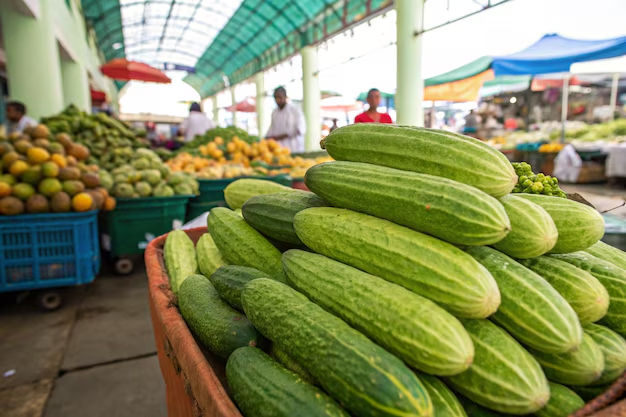
Ask three different people in India what they paid for cucumber last week and you'll get three completely different answers. That's not inconsistency — it's the reality of how India's produce pricing works.
A wholesale buyer at Bangalore's APMC Binny Mill market paid ₹18–20 per kg on a Tuesday in February 2026. A home cook in Mumbai paid ₹32/kg at the local vegetable stall the same day. A restaurant procurement manager in Delhi paying through a B2B platform like Hyperpure paid ₹17/kg for economy grade — or ₹28/kg for big-size premium. And someone ordering on Flipkart Supermart paid ₹46–49/kg for the convenience of home delivery.
Same vegetable. Same country. Prices spanning ₹17 to ₹49 per kg simultaneously. That's India's cucumber market.
Understanding where you sit in that price spectrum — and why — is the difference between efficient procurement and unnecessarily inflated costs. Whether you're a restaurant owner, a wholesale trader, a home buyer, or an international buyer sourcing Indian cucumber, this breakdown covers every price level, every channel, and every factor that drives the differences.
₹20/kgNational mandi rate (Feb 2026, Agmarknet)
₹21.6/kgMaharashtra state mandi average
3–7 pcsPer kg for standard Indian cucumber
6 daysTypical shelf life fresh cucumber
The numbers above tell the first part of the story. But cucumber prices in India are far more nuanced than any single national average can capture. Let's break down every dimension that matters.
Cucumber Price in India by City: A Direct Comparison

India's cucumber prices vary significantly between cities. The key driver is proximity to growing zones. Cities in southern India — particularly Bangalore and Hyderabad — sit closest to the country's most productive cucumber-growing regions in Karnataka and Andhra Pradesh, giving them a persistent price advantage over northern metros.
🌿
Bangalore
APMC: ₹18–20/kg
Retail: ₹25–40/kg
🏙️
Mumbai
Maharashtra mandi: ₹21.6/kg
Retail: ₹32–50/kg
🏛️
Delhi
Azadpur mandi: ₹18–25/kg
Retail: ₹35–55/kg
🌊
Chennai
Koyambedu: ₹16–22/kg
Retail: ₹28–45/kg
💎
Hyderabad
Bowenpally: ₹15–22/kg
Retail: ₹25–40/kg
🌾
Pune
Market Yard: ₹18–24/kg
Retail: ₹28–45/kg
Bangalore's APMC markets at Binny Mill and Channapatana consistently report among India's lowest cucumber mandi prices. The Channapatana APMC rate of ₹12–20/kg reflects direct access to Karnataka's cucumber belt — where farmers in Kolar, Tumkur, and surrounding districts produce significant volumes year-round under protected cultivation and open-field conditions.
Delhi's price premium over southern cities is largely a transport cost story. Cucumber from Himachal Pradesh and Uttarakhand (mountain-grown, popular in summer) or from Haryana and UP (winter and spring production) travels 200–600km to reach Delhi's Azadpur mandi. Fuel costs, vehicle hire, and toll charges all add to the landed price before a single rupee of wholesale markup is applied.
Mumbai's retail prices at ₹32/kg reflect Maharashtra's own production (Pune district, Nashik) combined with inter-state supply from Karnataka and Andhra Pradesh. The Mumbai market's premium retail infrastructure — supermarkets, premium grocery chains, and urban delivery apps — applies larger markups than wet market vendors, pushing consumer-facing prices toward ₹40–50/kg in organised retail.
APMC vs retail: the markup gap: In all Indian cities, the gap between APMC mandi price and consumer retail price for cucumber is typically 50–150%. A mandi rate of ₹20/kg becomes ₹35–50/kg at a retail vegetable vendor — absorbing transport from mandi to neighbourhood, vendor margin, wastage allowance, and in some cases, cold storage costs. Buyers who can access mandis directly or purchase through B2B platforms with mandi-linked pricing capture most of that margin for themselves.
Cucumber Varieties and Their Price Differences in India
One of the most under-discussed aspects of India's cucumber market is how dramatically variety affects price. "Cucumber" in Indian markets is not a single uniform product — it spans at least five commercially distinct varieties with different consumer profiles, production costs, and price points.
🥒
Economy / Standard Indian
₹17–22/kg
Mix size, hybrid, striped skin. Bulk foodservice grade. Most affordable. Hyperpure wholesale entry price.
🌿
Desi Kheera
₹36–43/kg
Traditional Indian variety. Mildly bitter, thin skin. Preferred for salads and raitas. Premium over standard.
⬜
White Cucumber
₹34–40/kg
Lighter skin, mild flavour. Popular in South India. Slightly above standard in price due to limited cultivation.
🟤
Mangalore Cucumber
₹36–40/kg
Regional specialty. Large, round, yellow-green skin. Used in sambar and coastal Karnataka cuisine.
🫙
European (Dutch) Cucumber
₹50–80/kg
Long, smooth-skinned. Premium retail and HORECA. Imported or domestic protected cultivation. Highest price tier.
The price gap between economy grade (₹17–22/kg) and European-type cucumber (₹50–80/kg) represents the full range of India's commercial cucumber market. Most of the volume — and the national mandi average — sits at the economy-standard Indian end. Premium varieties like desi kheera, white cucumber, and Mangalore cucumber occupy a mid-market segment. European cucumber is a niche product, grown under protected cultivation for premium hotels, restaurants, and high-income urban consumers.
The big-size premium is also notable. Hyperpure's wholesale pricing shows a clear jump from ₹17/kg (economy mix-size) to ₹26–28/kg (big-size premium) for the same basic Indian variety — a 50–65% premium purely for consistent sizing. This sizing premium reflects what B2B buyers in hospitality and modern retail actually need: uniform product that minimises prep time and food waste.
Cucumber Price Channels in India: From Mandi to Doorstep
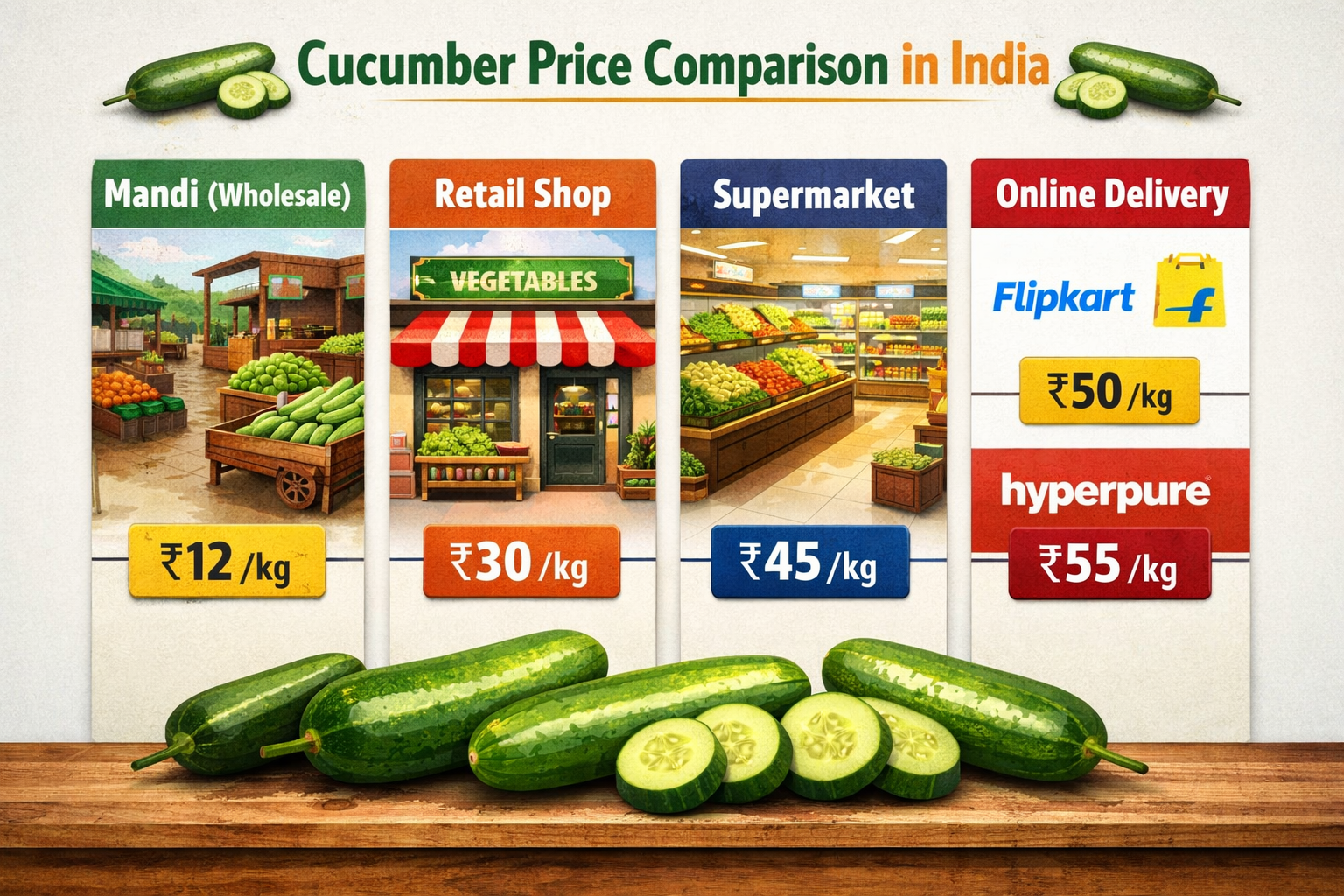
The channel you buy through determines your price as much as the variety you choose. India's cucumber distribution passes through multiple pricing layers from farm to consumer.
🥒 Cucumber Price by Channel in India (₹ per kg — standard Indian variety)
Wet Market Retail
₹32 avg
Premium (European)
₹65 avg
| Channel | Price Range (₹/kg) | Minimum Buy | Best For | Access |
|---|
| APMC Mandi | ₹12–20 | 50–100 kg+ | Bulk traders, restaurants | Direct |
| Hyperpure / B2B | ₹17–28 | 5–10 kg | HORECA, cloud kitchens | Platform |
| Wet Market | ₹25–40 | 500g–1 kg | Households, small buyers | Local |
| Supermarket | ₹35–50 | 500g–1 kg | Urban consumers, branded | Organised |
| Online Grocery | ₹46–49 | 500g–1 kg | Convenience-driven buyers | App/web |
| European variety | ₹50–80 | Varies | Premium retail, hotels | Specialty |
The online delivery premium is particularly visible in India's cucumber market. Flipkart Supermart pricing of ₹46–49/kg for local cucumber represents approximately 2.5× the APMC mandi rate for the same product. That premium pays for last-mile logistics, platform fees, seller margin, and packaging. For consumers who value time over money, the convenience price is acceptable. For volume buyers, it represents a significant opportunity cost.
Cucumber Price Seasonality in India: When Prices Are Lowest
📅 India Cucumber Price Seasonality — Monthly Price Level Overview
Jan
Feb
Mar
Apr
May
Jun
Jul
Aug
Sep
Oct
Nov
Dec
Peak supply — lowest prices
Good supply — moderate prices
Transitional — variable prices
Low supply — highest prices
India's cucumber price seasonality follows the pattern of its dominant growing seasons. The spring flush (March–May) produces the country's highest supply volumes and lowest mandi prices. Multiple growing states — Karnataka, Andhra Pradesh, Maharashtra, and Himachal Pradesh — contribute to a near-simultaneous production peak that floods wholesale markets with supply.
The monsoon period (July–August) creates the opposite condition. Heavy rainfall disrupts logistics, damages crops, and reduces mandi arrivals. Prices regularly spike during sustained rainfall weeks. The mandi data's recorded high of ₹100/kg likely reflects one such weather-driven supply shock — a price level that is 20× the recorded low of ₹4.5/kg from a peak-supply period.
Winter (October–January) sees moderate prices across most of India. Cooler temperatures allow good cucumber production in the plains, and the lack of monsoon disruption keeps supply chains stable. Maharashtra's winter cucumber from Pune and Nashik districts is particularly reliable in this period.
Procurement timing strategy: For institutional buyers — hotels, food processors, catering companies — the most cost-effective cucumber procurement window is typically March through May, when mandi prices are at their annual lows. Buyers with cold storage capacity can purchase and store during this window. Those without storage should focus on supplier contracts that lock in rates tied to seasonal mandi benchmarks rather than spot-market retail pricing.
What Drives India's Extreme Cucumber Price Swings

The ₹4.5 to ₹100/kg price range is not an anomaly — it accurately reflects the volatility that characterises India's fresh produce markets. Several structural factors produce this extreme spread.
Geographic Fragmentation
India's cucumber is grown across dozens of states with different climate calendars. Karnataka, Andhra Pradesh, and Tamil Nadu dominate winter-to-spring supply. Himachal Pradesh and Uttarakhand contribute summer mountain-grown cucumber when plains production slows. Maharashtra and Gujarat produce across seasons. When these regions' harvest peaks align, national supply spikes and prices collapse. When they don't, pockets of shortage drive local prices up sharply.
Cold Chain Gaps
Cucumber has a shelf life of approximately six days. Without refrigerated transport and storage, a significant percentage of each day's harvest reaches consumers or spoils. India's cold chain for vegetables has improved significantly but remains incomplete. In areas where cold chain is weak, post-harvest losses are incorporated into the effective cost per kg that reaches buyers — artificially inflating prices above what raw mandi rates suggest.
Monsoon Disruption
India's southwest monsoon (June–September) is simultaneously the growing season for some producing regions and a logistics nightmare for others. Flooded roads, waterlogged fields, and interrupted supply chains can reduce mandi arrivals dramatically during sustained rain events. The resulting supply shocks are fast and steep — ₹20/kg commodity can become ₹80/kg within a week if a major producing district is cut off by flooding.
Varietal Premiums and Consumer Preferences
As urban Indian consumers become more food-literate, demand for specific varieties — particularly desi kheera, Mangalore cucumber, and European-type long cucumber — has grown. These varieties command meaningful premiums over standard commodity grade. The growing HORECA sector (hotels, restaurants, catering) specifies size grades and consistency that the commodity mandi supply chain wasn't designed to provide — creating a premium procurement segment with its own pricing logic.
India's Cucumber Export Price: Global Competitiveness
India's position in global cucumber trade is defined by one statistic: an export price of approximately $0.28 per kg — the lowest among major exporting nations.
For context, Spain's wholesale cucumber price is $1.02/kg, Turkey's is $0.59/kg, and Egypt's is $0.40–$0.80/kg. India's $0.28/kg makes it the world's most cost-competitive cucumber supplier by a meaningful margin. This reflects the country's very low agricultural production costs — land, labour, water, and inputs — combined with significant production scale.
India's primary fresh cucumber export markets are the Gulf states: UAE, Saudi Arabia, Kuwait, and Bahrain. Proximity via the Arabian Sea means transit times are competitive. However, India faces challenges on post-harvest quality — the cold chain limitations that affect domestic distribution also affect the condition in which product arrives at destination, making consistent export quality a more significant challenge than raw price competitiveness alone.
International buyers' note on Indian cucumber: India's price competitiveness is genuine and substantial. However, buyers should specify grading standards, maximum pesticide residue limits aligned with destination market regulations (particularly EU MRL standards), and packaging specifications explicitly in purchase contracts. Cold chain continuity from farm to port is the key variable that separates reliable Indian exporters from inconsistent ones. Buyers should verify exporters' track record on temperature-monitored logistics and phytosanitary documentation before committing to volume orders.
📊
Related Reading
Cucumber Price Index: Wholesale, Retail & Bulk Sourcing Costs Across Global Markets →
Frequently Asked Questions: Cucumber Price in India
What is the price of cucumber per kg in India?
The national average mandi rate is approximately ₹20/kg based on Agmarknet data. However prices vary significantly: the mandi range spans from ₹4.5/kg (peak supply) to ₹100/kg (peak shortage). Retail prices in major cities are typically ₹30–60/kg. Online delivery platforms price cucumber at ₹46–49/kg. B2B wholesale platforms like Hyperpure supply at ₹17–28/kg depending on volume and grade.
What is the mandi rate of cucumber in India?
India's cucumber mandi rate fluctuates daily. The national benchmark as of February 2026 was approximately ₹20/kg. Maharashtra mandi rate was ₹21.6/kg. Bangalore APMC (Binny Mill) was ₹18–20/kg. Channapatana APMC was ₹12–20/kg. For current live rates, Agmarknet is the government's official mandi price platform covering mandis across all states.
Which city has the cheapest cucumber prices in India?
Bangalore, Hyderabad, and Chennai typically have the lowest cucumber prices, benefiting from proximity to Karnataka, Andhra Pradesh, and Tamil Nadu growing regions. Bangalore APMC prices consistently sit at ₹18–20/kg mandi rate. Delhi and Mumbai carry higher retail prices due to longer supply chains and premium retail infrastructure adding to the final consumer price.
What is the difference between desi and hybrid cucumber prices in India?
Economy/standard Indian hybrid cucumber at wholesale is ₹17–22/kg. Desi kheera commands ₹36–43/kg — roughly 80–100% more. White cucumber is ₹34–40/kg; Mangalore cucumber is ₹36–40/kg. European (Dutch-type) cucumber is the most expensive at ₹50–80/kg in premium retail. The premium reflects production cost, consumer preference, limited supply, and the specific cultivation requirements of each variety.
Why does cucumber price vary so much in India?
India's ₹4.5 to ₹100/kg price range reflects several factors: seasonal production peaks and troughs, geographic fragmentation across producing states, monsoon disruption of logistics, cold chain limitations increasing effective per-kg costs, and channel markups from mandi to retail adding 50–150%. Variety premiums add further variation — European cucumber at ₹50–80/kg occupies an entirely different market segment from commodity grade at ₹17–22/kg.
What is India's cucumber export price per kg?
India's cucumber export price is approximately $0.28 per kg — the lowest among major exporting nations globally. India's primary export markets are Gulf states (UAE, Saudi Arabia, Kuwait). The low price reflects India's very low agricultural production costs. However, consistent cold chain quality from farm to port is the key variable that determines export market success for Indian cucumber exporters.
