
Green Mango Philippines: Varieties, Flavour, Culinary Uses & Nutritional Properties
Manggang hilaw is far more than an unripe fruit in the Philippines — it is a cultural staple, a street food icon, a culinary ingredient, and one of the most versatile produce items in the Filipino kitchen.
- Manggang hilaw = unripe Philippine mango — sour, firm, crisp
- Carabao is the gold-standard variety — unripe or ripe
- Higher vitamin C than ripe mango at the same weight
- Eaten fresh with bagoong, pickled, dried, and used in kinilaw
- Culturally embedded — sold everywhere from street carts to supermarkets
- Major export product in dried and processed form worldwide

Manggang hilaw — freshly sliced Philippine green mango served with coarse salt and bagoong (fermented shrimp paste) at a street vendor. This combination is one of the most iconic Filipino street food pairings, unchanged across generations.
Ask any Filipino what they reach for when they want something sour, and the answer is almost always the same. Green mango. Crisp, astringent, intensely sour, and impossibly refreshing — manggang hilaw is one of those foods that exists in the cultural memory of an entire nation.
The Philippines is famous worldwide for producing the sweetest mango on earth. What is less known internationally is that Filipinos eat that same mango unripe — and love it at least as much as the ripe version. Green mango culture in the Philippines is deep-rooted, spanning street food, home cooking, traditional preservation techniques, and a multi-million-dollar processed food export industry.
Green mango in the Philippine context is not a distinct variety. It is the same fruit — primarily the celebrated Carabao mango — harvested before ripening, when the flesh is white to pale yellow, intensely firm, and charged with malic and citric acids that make every bite pucker-worthy.
Understanding Philippine green mango means understanding how a single fruit serves entirely different purposes depending on when it is picked. It is a study in how Filipino food culture finds value at every stage of a fruit's development — and how that cultural relationship has translated into one of the country's most recognisable export products.
What Is Manggang Hilaw? Understanding Philippine Green Mango
Manggang hilaw literally translates as "raw mango" or "unripe mango" in Tagalog. But calling it simply "unripe" undersells its cultural status. Manggang hilaw is a food category in its own right — consumed deliberately at a specific stage of development for qualities that disappear entirely as the fruit ripens.
The sour, astringent bite of a green mango comes from its acid composition. At the unripe stage, Philippine mangoes are rich in malic acid and citric acid. As the fruit ripens, these acids convert to sugars, producing the famous sweetness of the ripe Carabao mango. Green mango captures the fruit at the acid peak — before that conversion begins in earnest.
The flesh at this stage is also physically different. It is dense, hard, and brilliantly crisp — more like a firm apple than the soft, yielding texture of a ripe mango. When sliced, it holds its shape. When bitten, it snaps. These textural properties make it ideal for eating raw, for pickling (where it holds structure through the brining process), and for drying (where the density allows for a satisfying chew in the finished product).
Green mango is sold at every level of Filipino commerce — from roadside vendors with whole uncut mangoes in baskets to supermarkets with pre-sliced portions in sealed trays. Street food stalls peel and slice it to order, often serving it straight from the vendor's hands with a small tub of bagoong on the side.
Manggang batong vs manggang hilaw: In some Philippine regions — particularly in the Visayas — fully hard, very young green mango (harvested early while still stone-hard) is called manggang batong ("stone mango"). This is considered even more intensely sour than standard hilaw and is favoured for certain pickling and souring applications. Standard manggang hilaw is harvested slightly later, when the fruit has reached full size but before any ripening has begun.
Philippine Green Mango Varieties: Which Mangoes Are Eaten Unripe

Philippine mango varieties eaten green — each has a distinct flavour profile, texture, and preferred culinary application. The Carabao variety (second from left) remains the gold standard for both green and ripe consumption.
While the Carabao dominates, several mango varieties are eaten green in the Philippines. Each brings slightly different qualities to the table.
Carabao Mango
The gold standard. Intensely sour unripe, intensely sweet ripe. Firm white flesh, kidney-shaped. Preferred for eating raw with bagoong and for premium dried green mango export.
Indian Mango
Larger and rounder than Carabao. Less complex flavour but very firm flesh ideal for kinilaw, ensaladang mangga, and pickling. Widely available and affordable.
Pahutan
Technically a different species from Mangifera indica. Has a slightly resinous, pine-like note alongside sourness. Used in regional Visayan and Mindanaoan dishes. Less common commercially.
Piko Mango
Small, pointed variety found in specific Philippine regions. Very sour even by green mango standards. Prized for pickling and souring dishes like sinigang and kare-kare.
The Carabao variety's dominance in the green mango market mirrors its dominance in the ripe market. Its balanced acidity — intensely sour but not astringent to the point of bitterness — makes it the most eating-friendly green mango. When the Philippine government registered the Carabao mango under geographical indication protections, it cemented the variety's status as a national produce treasure at all stages of ripeness.
Culinary Uses of Green Mango in the Philippines
No ingredient in Philippine cuisine spans as wide a culinary range as green mango. It functions as a souring agent, a fresh vegetable, a condiment base, a pickling subject, and a snack in its own right — often simultaneously in a single meal.
The bagoong and green mango pairing deserves particular attention because it represents something deeper than simple taste preference. It is a case study in contrast-based flavour pairing: the sharp, clean sourness of the mango's acids cuts through the pungent saltiness of the fermented shrimp paste, creating a combination where each element intensifies the other rather than competing with it.
Sinigang sa mangga — sour soup with green mango — represents a regional variant of the Philippines' most beloved soup. While tamarind (sampalok) is the most common souring agent for sinigang, green mango produces a lighter, fruitier acidity with a background sweetness that makes the broth distinctly different from its tamarind counterpart. This version is particularly popular in Pampanga and Batangas provinces.
Nutritional Properties of Philippine Green Mango
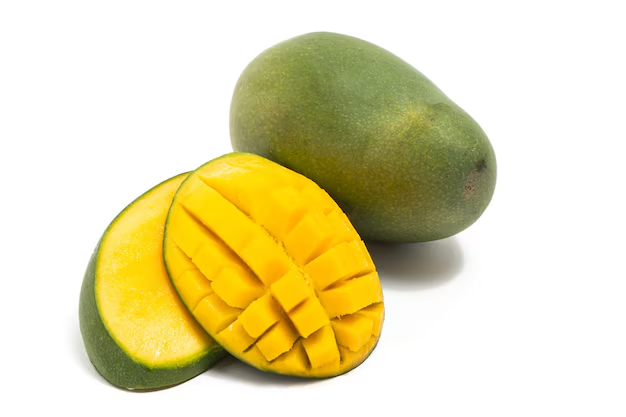
The dense white flesh of a freshly sliced Philippine green mango — packed with vitamin C, fibre, and organic acids. The crisp, firm texture is a function of the cell wall structure that softens as the fruit ripens and converts its acids to sugars.
| Nutrient | Per 100g Green Mango | % Daily Value | Notes |
|---|---|---|---|
| Calories | 60 kcal | 3% | Low energy density |
| Carbohydrates | 14.9g | 5% | Mostly organic acids + starch |
| Dietary Fibre | 1.6g | 6% | Both soluble and insoluble |
| Sugars | 9.9g | — | Much lower than ripe mango |
| Protein | 0.8g | 2% | Negligible |
| Fat | 0.4g | <1% | Essentially fat-free |
| Vitamin C | 46mg | Higher than ripe mango | |
| Vitamin B6 | 0.134mg | 8% | Supports brain function |
| Folate (B9) | 43mcg | 11% | Cell division, pregnancy support |
| Vitamin K | 4.2mcg | 5% | Blood coagulation |
| Potassium | 168mg | 4% | Electrolyte balance |
| Copper | 0.11mg | 12% | Iron metabolism, connective tissue |
| Malic + Citric Acids | Significant | — | Source of characteristic sourness |
Green mango's most nutritionally distinctive property compared to ripe mango is its vitamin C content. Unripe mango has measurably higher concentrations of ascorbic acid than the same fruit at ripeness — a consequence of the conversion processes that accompany ripening. For Filipinos who eat green mango regularly, it represents a significant dietary vitamin C source.
The organic acids in green mango — primarily malic acid — also stimulate digestive enzyme production. This is part of the reason green mango is traditionally eaten before or alongside a heavy meal in Filipino households. It prepares the digestive system for protein-heavy dishes like lechon, grilled pork, or seafood.
Green Mango vs Ripe Mango: How They Compare
The green and ripe stages of the same Philippine Carabao mango are almost nutritionally and texturally opposite. Understanding the difference clarifies why each serves such distinct culinary purposes.
| Property | 🟢 Green Mango (Hilaw) | 🟡 Ripe Mango (Hinog) |
|---|---|---|
| Flavour | Intensely sour, astringent | Sweet, floral, tropical |
| Texture | Very firm, crisp, dense | Soft, yielding, juicy |
| Colour (flesh) | White to pale yellow-green | Deep yellow to orange |
| Calories (100g) | ~60 kcal | ~70 kcal |
| Vitamin C | 46mg (51% DV) | 36mg (40% DV) |
| Sugar content | Lower (~10g) | Higher (~14g) |
| Dominant acids | Malic, citric — high | Much reduced — mostly converted |
| Glycaemic impact | Lower | Moderate-higher |
| Key culinary role | Souring agent, fresh snack, pickling | Dessert, juice, fresh eating |
| Export form | Dried (sweet-sour), pickled, frozen | Fresh, dried, puree, juice |
This comparison reveals why Philippine food culture has developed separate, equally enthusiastic traditions around both stages. They are effectively two different foods from the same tree — offering complementary nutritional profiles and entirely different flavour experiences. No other widely exported tropical fruit has this dual-stage consumption culture as embedded as the Philippine mango.
Dried Philippine Green Mango: The Global Export Product
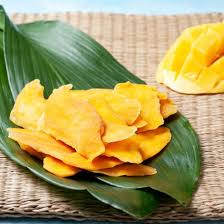
Dried Philippine green mango — primarily from the Carabao variety processed in Cebu — is one of the Philippines' most recognisable food exports, reaching Asian grocery stores, specialty food retailers, and online markets across Asia, North America, Europe, and the Middle East.
The most internationally visible form of Philippine green mango is the dried version — sliced Carabao mango, typically lightly sugared, dehydrated to a chewy consistency that balances sweet and sour in a distinctive combination that has made it a globally recognisable Filipino snack.
Profood International Corporation, the producer of Philippine Brand dried mango, has been the standard-bearer of this product since 1980. Based in Cebu — positioned centrally to access mango supply from all Philippine regions — the company exports to Asia, Europe, Canada, and the United States. Philippine Brand dried green mango is one of the Philippines' most widely distributed food products internationally.
What makes the dried version work commercially is precisely the green mango's pre-existing flavour intensity. The organic acids and moderate sugar content of unripe Carabao mango, when dried, concentrate into a tart-sweet combination that retains the characteristic "punch" of fresh green mango in a shelf-stable, portable format.
Processing distinction: Philippine dried "green mango" products vary in how green the source fruit actually is at harvest. The most tart versions use mangoes harvested at the earliest firm-hilaw stage. Slightly sweeter versions use mango harvested at "medium ripe" — still firm but with some natural sugar developing. Buyers should check sugar content on nutrition labels as a proxy for how early the source fruit was harvested.
How to select fresh green mango in Philippine markets: Choose mangoes that are completely firm throughout — no soft spots or give anywhere along the fruit. Skin should be uniformly bright green without yellowing around the stem (which indicates ripening has started). The best manggang hilaw for eating raw has a slight waxy sheen to the skin. For cooking in sinigang, slightly larger, more mature-but-still-green mangoes work best as their flavour is more fully developed.
Storing Philippine Green Mango: Keeping It Hilaw
Proper storage of green mango is critical because the fruit will continue ripening at room temperature. For buyers who want it to stay green and sour, this is the enemy.
At room temperature (28–32°C, typical Philippine ambient), a green Carabao mango will begin to ripen within 3–5 days of purchase. Signs are predictable: a yellow blush appears around the stem end, the flesh softens slightly, and the sourness begins to mellow.
Refrigeration significantly slows this process. At 10–13°C (the optimal temperature for mango cold storage), green mangoes will hold their hilaw state for 2–3 weeks. Temperatures below 10°C risk chilling injury — the flesh develops brown internal spots and the texture becomes mealy rather than crisp.
For commercial buyers and food service operators purchasing in volume, temperature management from harvest through delivery is the single most important quality factor for green mango. The difference between a mango that arrives perfectly hilaw and one that has started turning yellow during transit represents a significant quality and price differential at the Philippine market level.