
Avocado Properties: Nutrition, Fats, Vitamins & Physical Characteristics
Avocado is unlike almost any other fruit on the planet. Here's a complete, data-backed breakdown of its nutritional composition, fatty acid profile, micronutrient density, and what makes it genuinely exceptional.
- 77% of avocado calories come from healthy fats
- Oleic acid (MUFA) makes up ~70% of total fat content
- More potassium per gram than banana
- Contains lutein & zeaxanthin — rare in fruit
- Boosts absorption of fat-soluble nutrients from other foods
- Hass avocados are significantly higher in fat than Fuerte

A fully ripe Hass avocado — the world's most commercially traded variety — showing the characteristic dense, butter-coloured flesh that signals peak fat content and nutritional density.
Most fruits are built from sugar and water. Avocado is built from fat. That single fact separates it from almost everything else in the produce aisle — and it shapes every other property the fruit possesses.
The avocado, scientifically known as Persea americana, is botanically a large berry native to Central America. But its composition reads more like a nut than a typical fruit. Per 100g, it delivers 15 grams of fat — predominantly the same monounsaturated oleic acid that makes olive oil nutritionally prized — alongside a micronutrient density that few foods of any kind can match.
Understanding avocado properties in full means looking beyond the headline fat number. It means examining which fats, which vitamins, which phytochemicals, and which physical characteristics make this fruit genuinely exceptional — and what distinguishes one variety from another.
This article covers all of it. From macronutrient composition and fatty acid ratios to antioxidant profiles and variety comparisons, here is the most complete data-backed breakdown of avocado properties available.
What Makes Avocado Unique Among Fruits
The majority of fruits derive their energy from simple carbohydrates — fructose primarily, with minimal fat content. Avocado inverts this entirely. Roughly 77% of its calories come from fat, with carbohydrates contributing less than 10%.
This macronutrient inversion has direct consequences for how the body processes it. Avocado has minimal glycaemic impact. It does not spike blood sugar. It slows the digestion of carbohydrates consumed alongside it, helping to stabilise blood glucose — a property relevant for people managing insulin sensitivity and type 2 diabetes risk.
It is also one of very few fruits that contains meaningful concentrations of fat-soluble vitamins — E and K — and the carotenoids lutein and zeaxanthin, which are critical for eye health. These compounds simply cannot be present in useful concentrations without a fat matrix to carry them. Avocado provides that matrix naturally.
Perhaps most unusually, avocado acts as a nutrient absorption amplifier. Research has shown that adding avocado or avocado oil to a salad significantly increases the body's absorption of carotenoids — including alpha-carotene, beta-carotene, and lutein — from the other vegetables in that meal. The fat in avocado facilitates the absorption of fat-soluble nutrients from other foods simultaneously.
Full Nutritional Profile: Avocado Per 100g
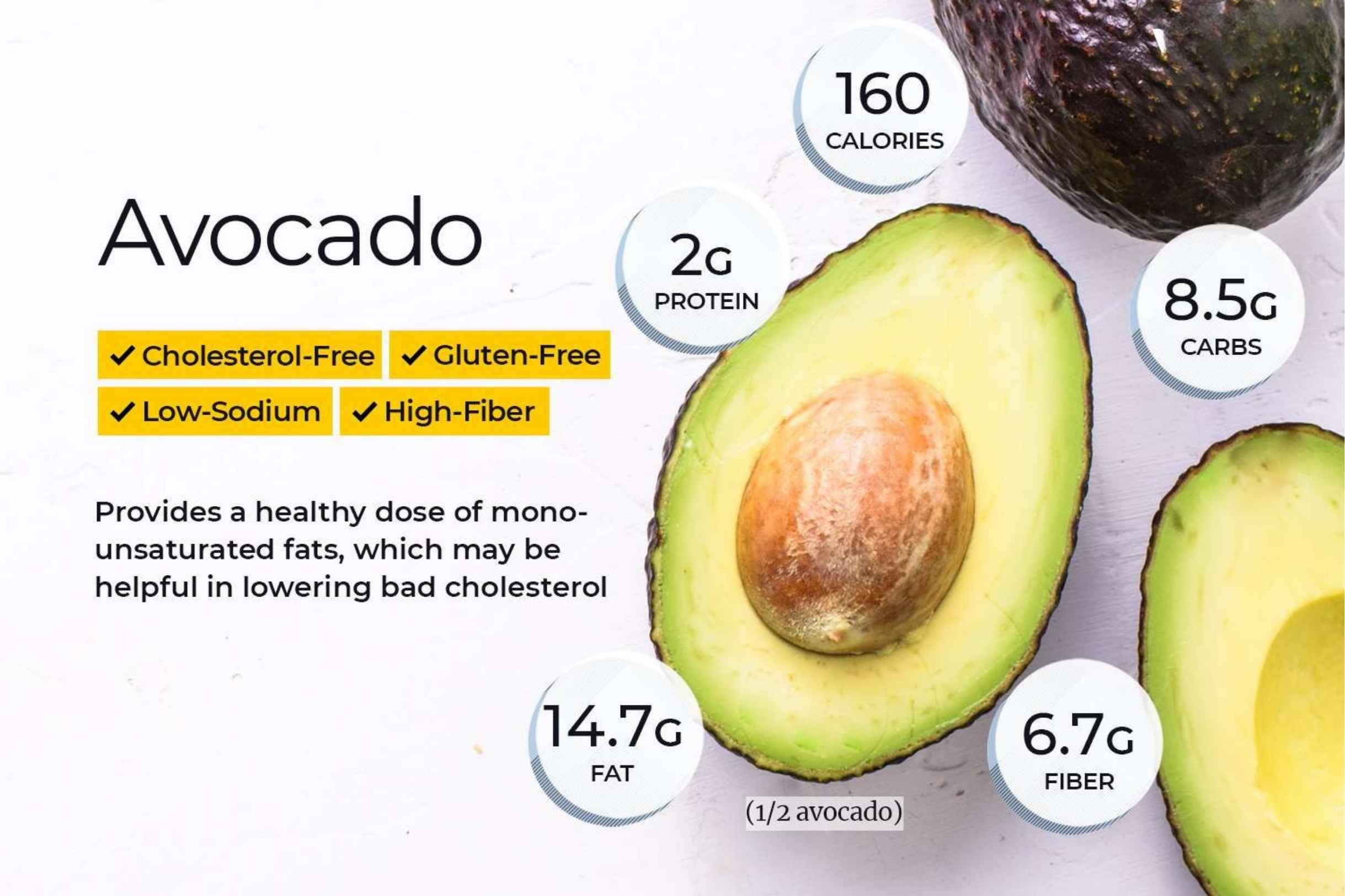
Avocado's nutritional composition is dominated by fats — primarily heart-healthy monounsaturated fatty acids — with a micronutrient profile spanning 20+ vitamins and minerals per 100g serving.
| Nutrient | Per 100g | % Daily Value* | Significance |
|---|---|---|---|
| Calories | 160 kcal | 8% | Moderate energy density |
| Total Fat | 14.7g | 19% | Primarily MUFA (oleic acid) |
| — Monounsaturated | 9.8g | — | Heart-healthy, anti-inflammatory |
| — Polyunsaturated | 1.8g | — | Includes omega-3 ALA |
| — Saturated | 2.1g | — | Lower than meat sources |
| Carbohydrates | 8.5g | 3% | Low glycaemic impact |
| Dietary Fibre | 6.7g | 24% | |
| Sugars | 0.7g | — | Negligible sugar content |
| Protein | 2.0g | 4% | Contains all essential amino acids |
| Potassium | 485mg | 10% | |
| Folate (B9) | 81mcg | 20% | Critical for cell division, pregnancy |
| Vitamin K | 21mcg | 18% | |
| Vitamin E | 2.1mg | 14% | Antioxidant, cell membrane protection |
| Vitamin C | 10mg | 11% | Immune support, collagen synthesis |
| Vitamin B5 (Pantothenic) | 1.4mg | 28% | |
| Vitamin B6 | 0.26mg | 15% | Neurotransmitter synthesis |
| Magnesium | 29mg | 7% | Muscle and nerve function |
| Copper | 0.19mg | 21% | Iron metabolism, connective tissue |
| Beta-sitosterol | 76mg | — | Plant sterol, cholesterol management |
| Lutein + Zeaxanthin | 271mcg | — | Eye health, UV protection |
*% Daily Value based on 2,000 calorie diet. Values for raw Hass avocado flesh.
The Fatty Acid Profile: Why Avocado Fat Is Nutritionally Prized
Not all dietary fat is equal. The specific fatty acid composition of a food determines its physiological effects — and avocado's fatty acid profile is one of the most favourable found in any whole food.
🥑 Avocado Fatty Acid Composition (% of total fat)
Oleic acid — the primary monounsaturated fat in avocado — is the same fatty acid that dominates extra virgin olive oil's composition. It has been associated in multiple clinical studies with reduced LDL ("bad") cholesterol, reduced systemic inflammation, and improved cardiovascular markers. Replacing saturated fats in the diet with oleic acid-rich foods consistently produces measurable health outcomes.
The polyunsaturated fraction includes alpha-linolenic acid (ALA), a plant-based omega-3 fatty acid. While ALA is less bioavailable than marine omega-3s (EPA and DHA), its presence adds to avocado's overall cardiovascular-protective profile.
Avocado vs olive oil comparison: Extra virgin olive oil is approximately 73% oleic acid. Avocado's flesh fat is approximately 70% oleic acid — essentially the same primary fatty acid, in a whole-food matrix that also delivers fibre, potassium, B vitamins, and antioxidants that refined oil cannot provide.
Antioxidant Properties: Carotenoids, Phytosterols, and Glutathione

The darker green flesh closest to the skin contains the highest concentration of carotenoids including lutein — up to three times more than the paler inner flesh. Thorough scooping rather than peeling preserves this nutrient-dense layer.
Avocado's antioxidant profile is unusually rich for a fruit and includes several compounds found in very few other commonly eaten foods.
Lutein & Zeaxanthin
271mcg per 100g. These carotenoids accumulate in the eye's macula, protecting against age-related macular degeneration and UV damage.
Glutathione
One of the body's master antioxidants. Avocado is among the highest glutathione food sources. Protects cells from oxidative damage at the molecular level.
Vitamin E (Tocopherols)
2.1mg per 100g. Fat-soluble antioxidant that protects cell membranes from lipid peroxidation. Works synergistically with avocado's MUFA content.
Beta-Sitosterol
76mg per 100g. Plant sterol that competes with cholesterol for intestinal absorption — associated with reduced total and LDL cholesterol in clinical studies.
Beta-sitosterol is worth particular attention. At 76mg per 100g, avocado provides one of the highest concentrations of this plant sterol found in any whole fruit. Beta-sitosterol has a chemical structure similar to cholesterol — it competes with dietary cholesterol for absorption in the intestine, reducing the amount that enters the bloodstream.
The darker green flesh layer directly beneath the skin also contains a higher concentration of phytochemicals, including polyphenols and flavonoids, compared to the pale inner flesh. This is why nutrient density is maximised by scooping flesh rather than peeling the skin away, which often removes this outer layer.
Physical Properties of Avocado: Skin, Flesh, and Seed
Understanding avocado's physical properties is essential for quality assessment, post-harvest management, and commercial grading.
Skin and shape. Avocado skin ranges from smooth green (Fuerte) to heavily pebbly and dark purple-black when fully ripe (Hass). The skin's thickness varies by variety — Hass has relatively thin but tough skin that is easy to peel when ripe, while larger varieties like Reed have thicker, more easily damaged skin. Avocados are pear-shaped, egg-shaped, or spherical depending on variety.
Flesh characteristics. Ripe avocado flesh is creamy, pale yellow-green, and has a characteristic buttery texture produced by its high oil content. The flesh closest to the skin is darker green and more fibrous. Flesh yellows and softens as ripening advances. Browning occurs rapidly after cutting due to enzymatic oxidation — the same PPO enzyme found in other fruits.
Seed. The large, single seed (pit) makes up approximately 13–18% of the total fruit weight. The seed is surrounded by the endocarp and is not edible in commercial consumption, though it has been studied for antimicrobial compounds in research contexts.
Ripening behaviour. Avocado is a climacteric fruit — it produces ethylene gas and ripens after harvest, not on the tree. Commercial avocados are harvested hard and unripe, then allowed to ripen in transit or at destination. This post-harvest ripening window is critical for shelf life management and quality delivery to buyers.
Ripeness testing: A ripe avocado yields to gentle pressure at the stem end without being soft throughout. The stem button should release easily and show green underneath (not brown, which indicates overripeness). Firmness is the most reliable quality indicator for commercial grading.
Nutritional Properties by Variety: Hass vs Fuerte
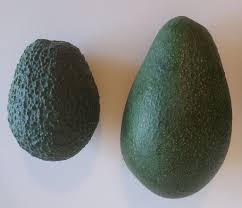
Hass (left) and Fuerte (right) are the two most commercially significant avocado varieties. Hass dominates global trade due to its longer shelf life and higher fat content — though Fuerte remains popular in specific regional markets.
Hass's higher fat content also means a higher concentration of fat-soluble vitamins and phytochemicals — including lutein, vitamin E, and beta-sitosterol — per gram of flesh. For nutritional density, Hass consistently outperforms lower-fat varieties. For calorie management, lighter varieties like Fuerte or Florida avocado provide a similar micronutrient range at lower energy density.
Anti-Inflammatory and Cardioprotective Properties
Avocado's combined nutritional properties converge on one consistent theme: cardiovascular protection. Multiple mechanisms operate simultaneously.
Oleic acid reduces LDL cholesterol when it replaces saturated fats in the diet. Beta-sitosterol reduces cholesterol absorption in the intestine. Potassium reduces blood pressure by countering sodium's vasoconstrictive effects. Fibre reduces the re-absorption of bile acids, lowering circulating cholesterol. Each mechanism is independent — together they create a compounding effect.
The anti-inflammatory properties work through a different pathway. Oleic acid suppresses the expression of pro-inflammatory cytokines including IL-6 and TNF-alpha. Lutein and zeaxanthin reduce oxidative stress in vascular tissue. Vitamin E protects LDL particles from oxidative damage that triggers the atherosclerotic process.
Folate deserves separate mention. At 81mcg per 100g — providing approximately 20% of the recommended daily intake — avocado is one of the best whole-food sources of this B vitamin. Folate is critical for DNA synthesis, cell division, and the prevention of neural tube defects during pregnancy. It also metabolises homocysteine, an amino acid associated with elevated cardiovascular disease risk when present in excess.